
Teenage Sex and Death at Camp Miasma
Jane Schoenbrun revels in the blood-soaked absurdities of the slasher, transforming the genre's familiar spectacles of sex and violence into an audacious expression of desire, artistic freedom and the unexpected intimacy of being understood.
2026 • Jane Schoenbrun • 112 min • MUBI • Horror / Romance
When Kris flees the inevitable coming of Little Death, she pauses for a beat long enough to remove her jeans. Schoenbrun demonstrates a profound reverence for the conventions of slasher cinema, embracing their absurdities while discovering remarkable new possibilities within them. The scantily dressed final girl, the masked killer and the pursuit through the wilderness are hallmarks of the genre that Schoenbrun understands intimately. They reproduce this familiar choreography with a ferocity that recalls the self-awareness of Wes Craven's Scream. The film's most extraordinary achievements, however, lie not in its choice to expose the absurdities of the genre, but in its ability to recognise the expressive possibilities those absurdities contain.
Hannah Einbinder's Kris Williams, a young filmmaker whose independent success has made her commercially attractive, has been enlisted by some unnamed Hollywood studio to revive the long-dormant Camp Miasma franchise. In accepting this deal, she is acutely aware of the limited creative freedom that is afforded to her; the studio's interest in her take on Miasma principally extends to the commercial possibilities of its masked antagonist, Little Death, whose mythology they expect to be reconstituted into a more palatable version for contemporary audiences. For Kris, however, Miasma is something altogether more personal. She has grown up watching the types of film she had no business watching as an eight-year-old, and the afterimage of those movies is seared into the person she has become.
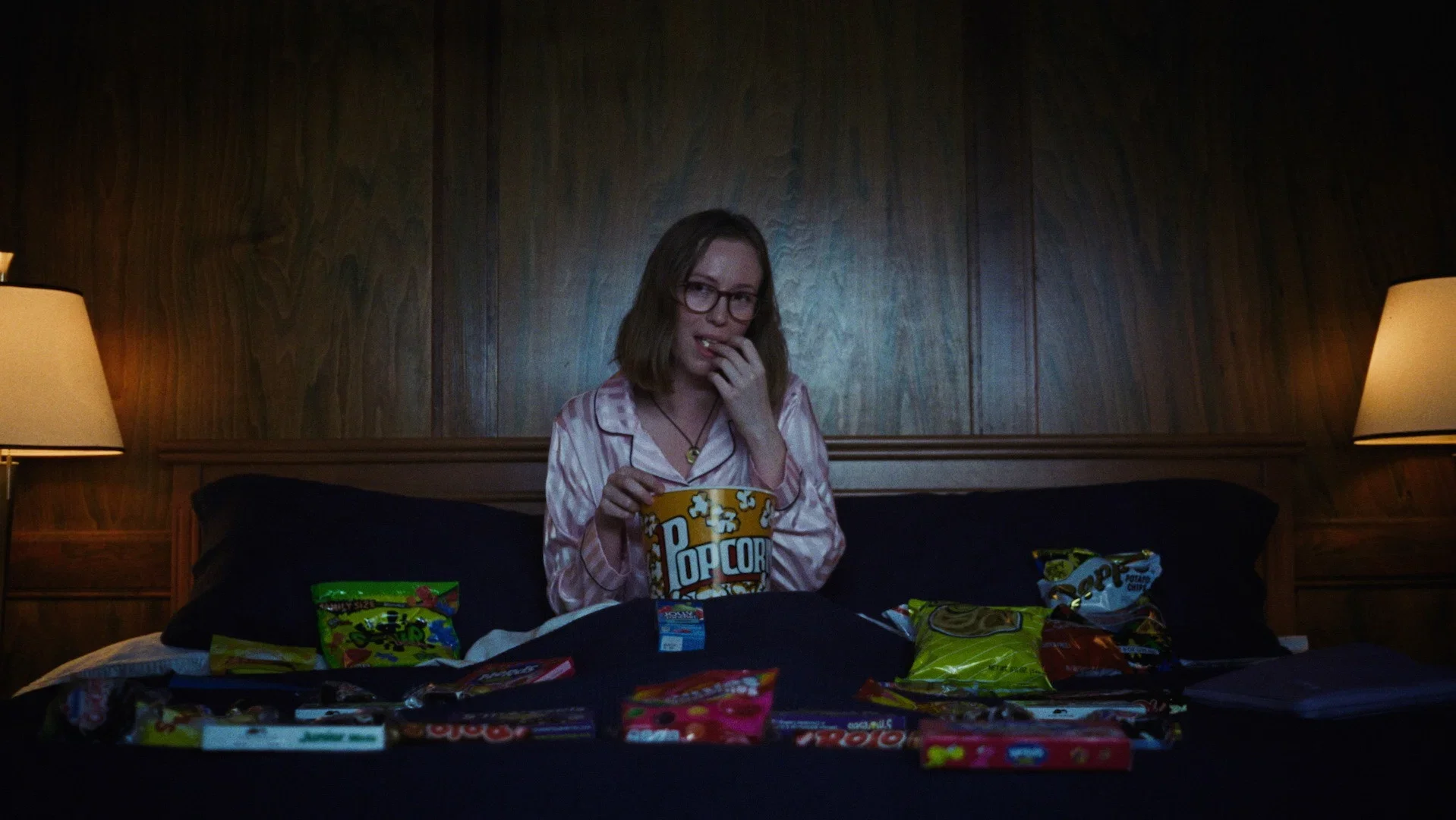
Despite her affinity for cinema, Kris cannot seem to embrace her desire for the screen without first subjecting it to an elaborate exercise in which she assigns it some intellectual justification. In private, however, she consumes films with avaricious pleasure. In a hotel room on the eve of her introduction to the remarkably reclusive Billy Presley, she sequesters herself from the world and surrounds herself with the trappings of the movie-going experience. Her capacity for indulgence sits uneasily alongside her relationship with sexual intimacy, which she articulates as something she has struggled to experience without retreating elsewhere in her imagination. This uncomfortable negotiation between intellectual composure and emotional vulnerability comes to characterise Einbinder's performance and there is a tension that simmers beneath even her most apparently assured exchanges.
Teenage Sex and Death at Camp Miasma (2026) • MUBI
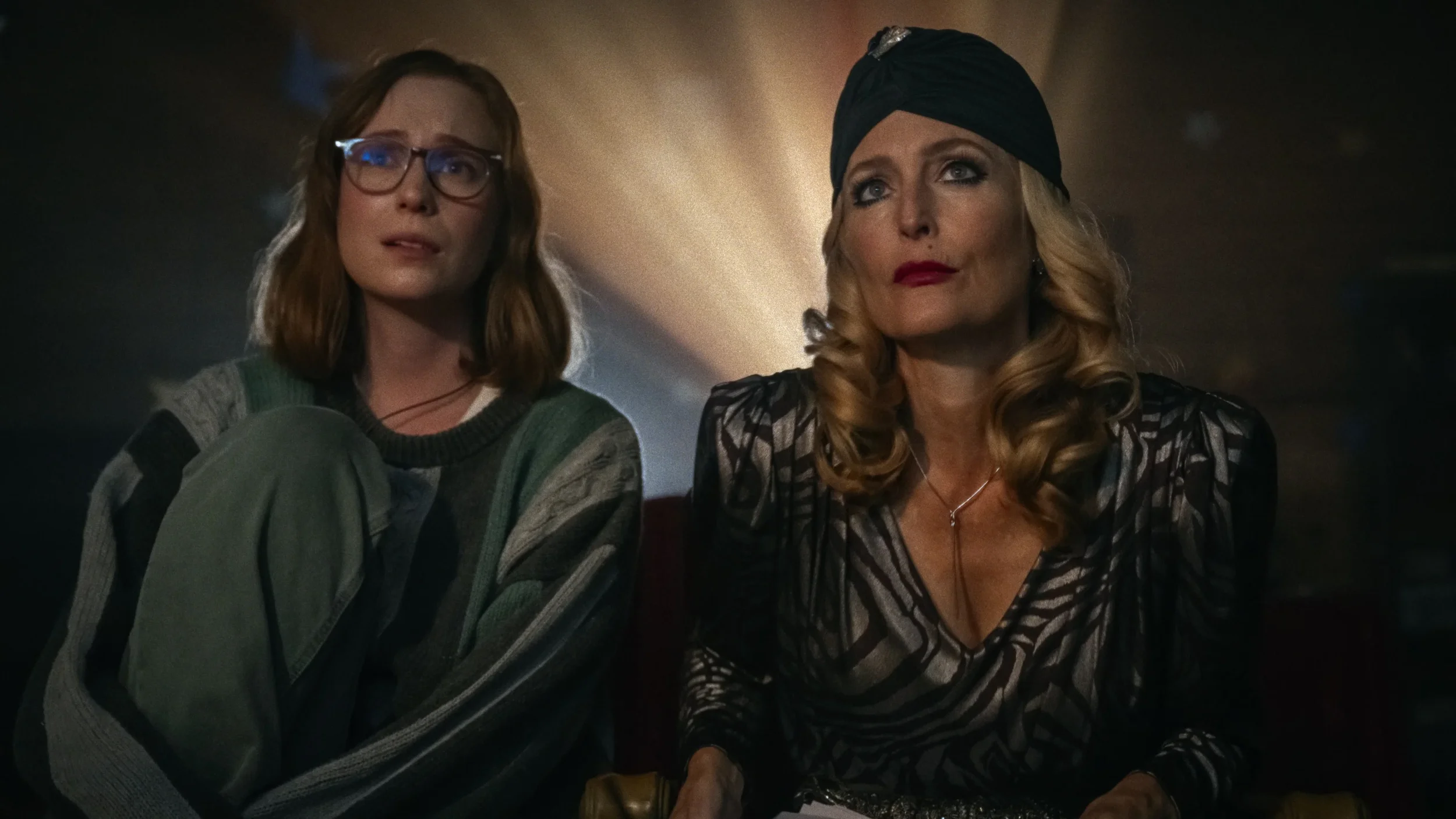
The solution to the quandary proposed by the studio's idea of Miasma's resurrection, Kris believes, lies with Billy Presley (portrayed with aplomb by Gillian Anderson in yet another screen-stealing role), the actress whose performance as the original film's final girl, Squeak, has fascinated Kris since her childhood. Billy is inhabited by Anderson with absolute, unerring conviction. Her distinctive vocal inflections, peculiar physicality and complete commitment to the character's eccentricities establish a woman who is no longer acquainted with the world and has long since withdrawn from public life. The mystique that surrounds Billy and her disappearance from the zeitgeist has done little to diminish a mythology the world created in her absence, a mythology she has seemingly not sought to escape. Instead, she has lived in embrace of the film that established her, fashioning a home out of the remnants of Camp Tivoli, the locale upon which the original Miasma was shot. Her fame, subsequent obscurity, and the enduring consequences of that first production have become inseparable from the person she has chosen to become.
The contrast between the two of them is immediately apparent and their increasingly intimate exchanges draw much of their humour and tenderness from that exact disparity. While Kris approaches their first meeting with professional apprehension and intellectual curiosity, Billy appears almost delighted by the possibility of unsettling her. Kris explores her new surroundings while Billy plates KFC and takes a beat to squeeze it, wondering aloud whether or not Kris likes dipping sauce.
Of course, she declares, she loves it.
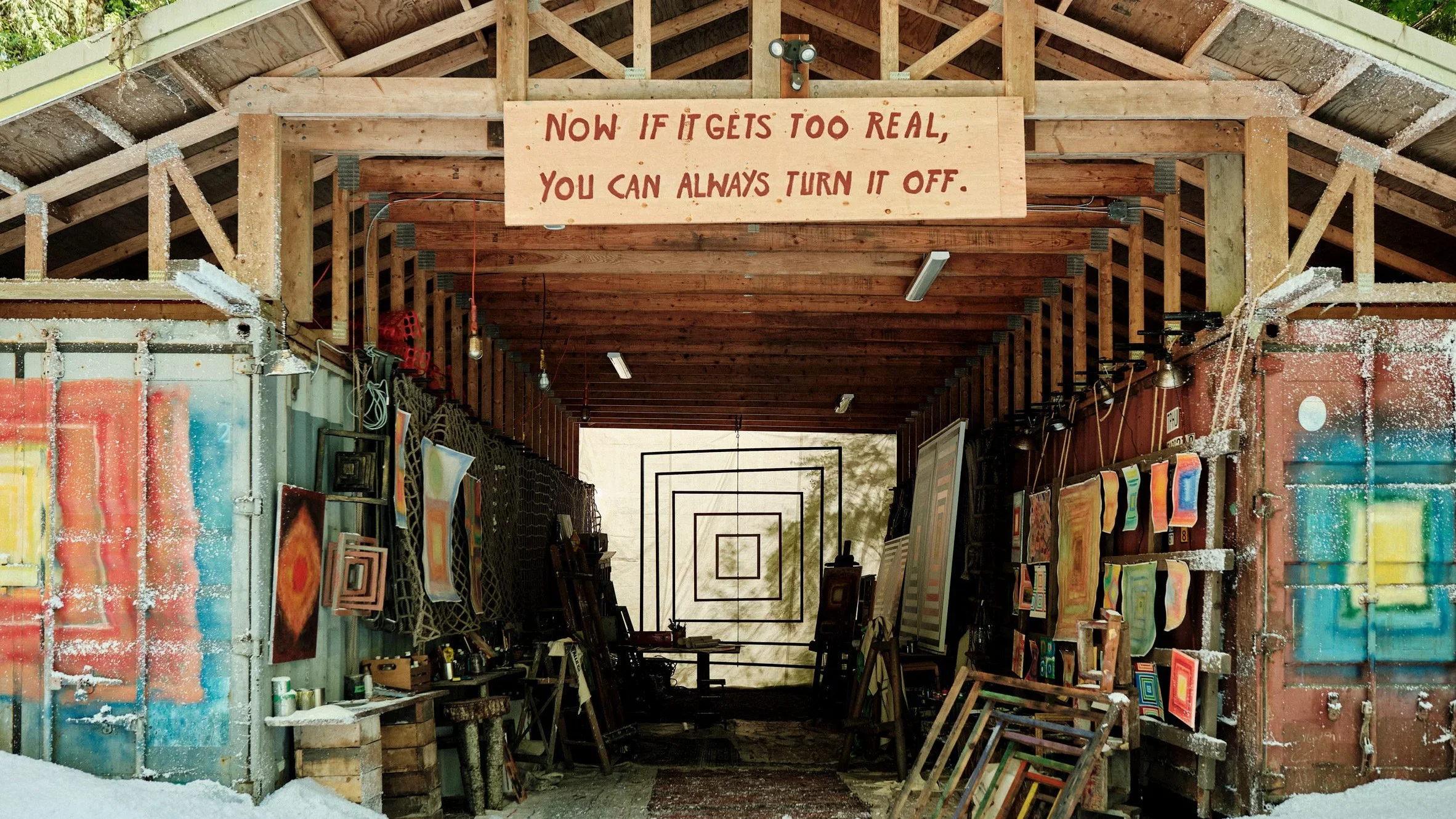
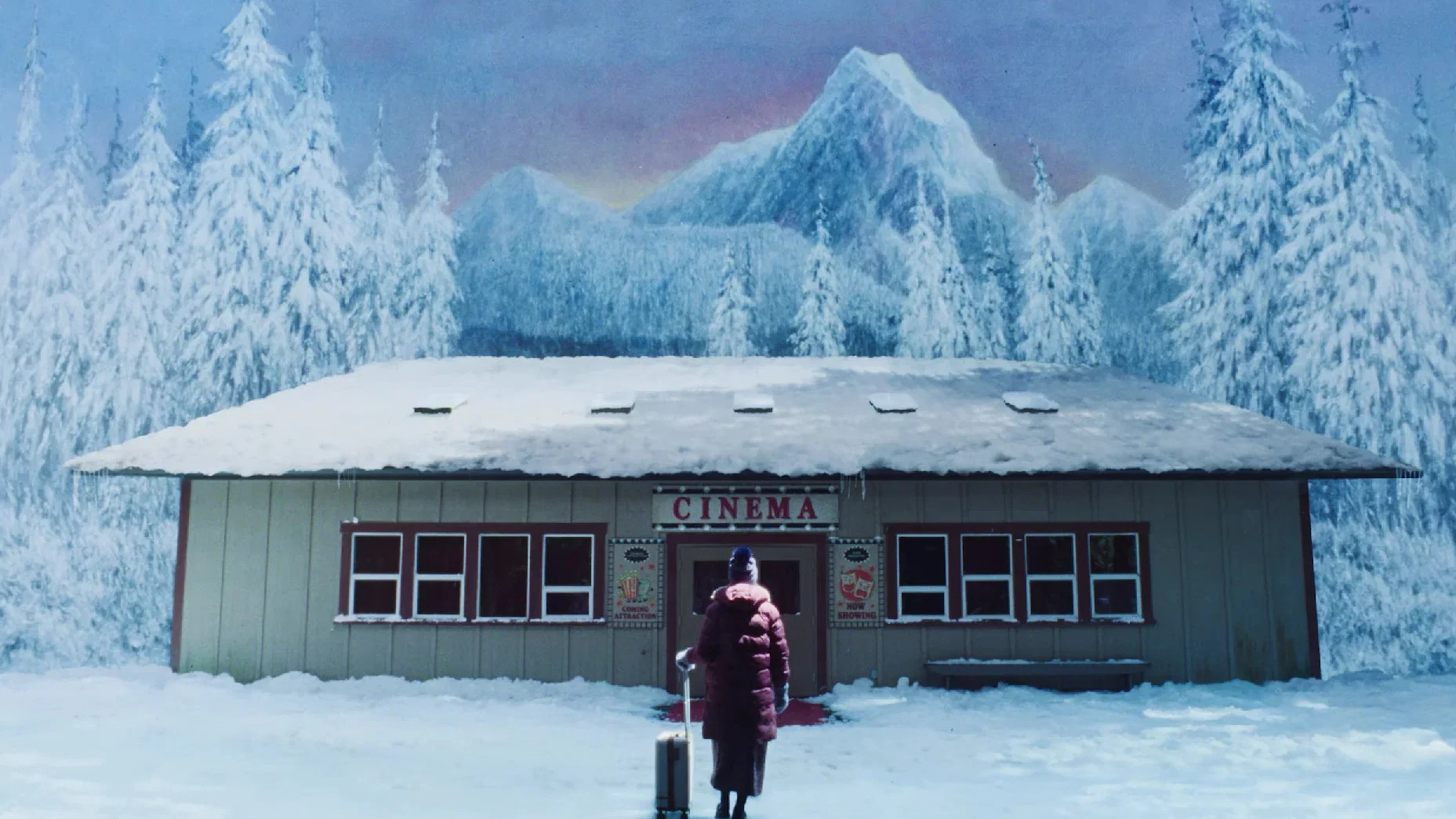
The production design makes that encounter all the more remarkable. The conspicuous artifice of Tivoli's surrounding landscape, constructed through gorgeous matte-painted backdrops, introduce an element of disquiet into a film that has, until Kris's arrival, inhabited a comparatively grounded reality. It is initially uncertain whether the film is moving towards outright fantasy or merely adopting a more theatrical visual language and, as Kris enters Billy's world, bound by painted scenery, she steps unknowingly into the fiction she has spent much of her life adoring. As Teenage Sex and Death at Camp Miasma progresses, the distinction between the two becomes increasingly difficult to establish.
That uncertainty is fundamental to the film's treatment of fantasy. Billy's existence within the construction of Miasma is no less authentic for having been fashioned from the materials of a now-abandoned fiction. It is the extraordinary conviction of Anderson's performance that, in fact, allows the theatricality of their environment to become an extension of her character rather than an elaborate disguise to conceal it. The painted landscapes of Camp Tivoli are not merely decorative flourishes; they are designed to gradually accommodate Kris's entry into a world where the ordinary separation between cinematic representation and lived experience is no longer entirely secure.
Teenage Sex and Death at Camp Miasma (2026) • MUBI
A screening of the original film brings the budding connection between Schoenbrun's leads into a sharper focus. The film invites the audience to experience the cinematic object around which so much of the characters' lives has been organised, constructing a violent, frequently amusing homage to horror cinema of the '70s and '80s. Its familiar iconography evokes the slasher tradition of A Nightmare on Elm Street and The Texas Chain Saw Massacre, although the extraordinary fluidity of the extended massacre sequence introduces a distinctly contemporary sensibility into the otherwise period-conscious filmmaking. While the incongruity is initially jarring, the sequence's movement through Little Death's perspective also establishes a relationship between spectatorship and violence that promises to become increasingly significant.
For Kris, the screening offers an opportunity to revisit images she is intimately familiar with. For Billy, those same images contain the record of a considerably more complicated history. The two women encounter the same film, yet approach it from profoundly different positions: one has been shaped by its reception, the other was shaped by its creation. As Billy watches her younger self, she begins sketching the unmistakable geometry of Little Death's helmet, an image that continues to occupy her imagination long after the production has ended. These drawings adorn the walls of her home and come to suggest not only something of the trauma she carries but also of the mythology she has chosen to incorporate into her life. Her relationship with the original film cannot simply be reduced to an inability, or refusal, to leave it behind.
Kris's fascination centres particularly on an expression captured in Squeak's eyes during the original film's climactic sexual encounter. She longs to understand the experience that produced it and approaches that image with the same analytical determination that has come to govern her relationship with cinema. Billy, however, is sceptical of such intellectualisation. To her, the pleasures of Miasma have always been concerned with something considerably more immediate: flesh and fluids. The apparent simplicity of that declaration reveals a fundamental difference in their attitudes towards desire. For Kris, understanding has become a means of maintaining distance from the experiences she finds most difficult to confront. For Billy, fantasy has long provided the means through which those experiences can be unlocked.
Billy's recollections of the original production complicate the distinction between the two. During the filming of Squeak's sexual encounter, an experience marked by violation, she discovered a means of experiencing pleasure by imagining herself through the gaze of Miasma's antagonist. The moment Kris has spent years attempting to understand was therefore neither mere performance, nor straightforward expression of desire, but an experience in which the boundaries between sexual intimacy, exploitation, dissociation and cinematic representation became profoundly entangled. Billy has carried these contradictions into her subsequent life.
Teenage Sex and Death at Camp Miasma (2026) • MUBI
Kris recognises something of herself in this account. She, too, has struggled to experience sexual pleasure without retreating into fantasy, finding herself unable to attain the intimacy that seems to come so readily to others. Her desires have instead become entangled with the images of the film, and particularly with the possibility of inhabiting Squeak's position within them. She does not merely desire the monster that traditionally threatens the final girl; she longs to become the woman whose experience of that threat has occupied her imagination since childhood. The monster's gaze becomes inseparable from her own desire to be seen, transforming the slasher's familiar relationship between sexual spectacle and violence into something more intimate.
Billy's insistence that their relationship is a form of play becomes essential to Kris's growing acceptance of those fantasies. The invitation to inhabit the artificial world of Miasma is accompanied by an understanding that the experience remains theirs to negotiate. Fantasy need not be denied its emotional significance merely because it is constructed, nor must its participants surrender agency to experience pleasure. As Kris allows Billy to understand the vulnerabilities she has concealed from even herself, the two women discover a connection that extends beyond their shared fascination with Miasma's place in the canon of cinema.
Their intimacy is therefore considerably more moving than its outrageous circumstances might suggest. As Billy guides Kris towards orgasm, something she has long considered inaccessible with a third party, the image of Little Death becomes the focus of a fantasy that no longer need remain private or shameful. They lie together in front of the fireplace, reconnecting after a brief interlude, triggered by Kris' discomfort which rears its head in the wake of being asked how she likes to be touched, and Billy reassures her that no matter what, she will not judge her. Schoenbrun frames the two of them in the orange light, impossibly close, suggesting that there is a likeness in their proximity, something between the two of them that will result in an understanding both have searched for and not yet found. The sequence is audacious and the camera hangs overhead from the perspective of none other than Little Death himself. The scene's emotional significance emerges from something we innately look for in others: the capacity to understand that which we may have found impossible to communicate. Sheer acceptance permits Kris the realisation that she is not required to abandon intellectual engagement in order to experience pleasure. In fact, she is finally able to recognise that the two never needed to have been incompatible.
Her increasing willingness to acknowledge that which she had previously refused is reflected in her professional transformation. Confronted by a studio whose ambitions for Miasma are principally commercial, Kris abandons the conciliatory approach with which she initially accepted the assignment. She embarks on a tirade in which she refuses to accommodate the expectations of the executives who hired her, demanding they recognise a reality Little Death has created. She asserts her artistic conviction in her decision to make Billy the lead of the reboot, something that reveals the studio's true connection to the Miasma franchise; they don't even know who Billy Presley is. Kris' personal independence and relationship with her own desire is brought to the fore as she becomes increasingly distressed, talking of Little Death and his barbarous mentality with such conviction that she becomes flushed, removes her clothes, and appears to experience that once-elusive pleasure she has recently discovered all over again. The studio executives, primarily concerned with the slasher's conventions as properties to be repackaged, and not wholly convinced by Kris ranting with near-sexual abandon, refuse to acknowledge that any version of Miasma can also possess artistic integrity. Kris' liberation is not a desecration of that belief but, instead, a convergence of her desires and a refusal to continue to be subordinate to the expectations of others.
By the time Little Death emerges once more, the film's familiar slasher conventions have acquired an entirely different significance. Kris has accepted Billy's offer to make a movie, though she is no longer where she imagined. Instead of behind the camera, she is in front of it, inhabiting the role of Miasma's final girl. They watch together as Little Death emerges from beneath the surface of the water and she implores Billy to push her down the hill, so that he will have a head start.
Naturally, Billy obliges.
In the rough and tumble of her collapse, Little Death edges closer and his spear is in the sand. Einbinder's performance here is laced with amusement and, when Kris pauses to remove her jeans, there is the flash of a smile. A perverse excitement at the proposition of being the subject of Miasma's brutal horror. Gleeful and terrified, she races through the woods as she escapes the connections tying her to her former life. Little Death plays his role of extravagant bloodletting, dispatching her former partner, Thor the bisexual king, her agent and the studio executives with visceral immediacy. Kris is no longer merely watching the cinematic fantasy that has come to shape her understanding of desire. Now, she is living in it, and Schoenbrun allows her to embrace the conventions whose absurdities they have been celebrating throughout.
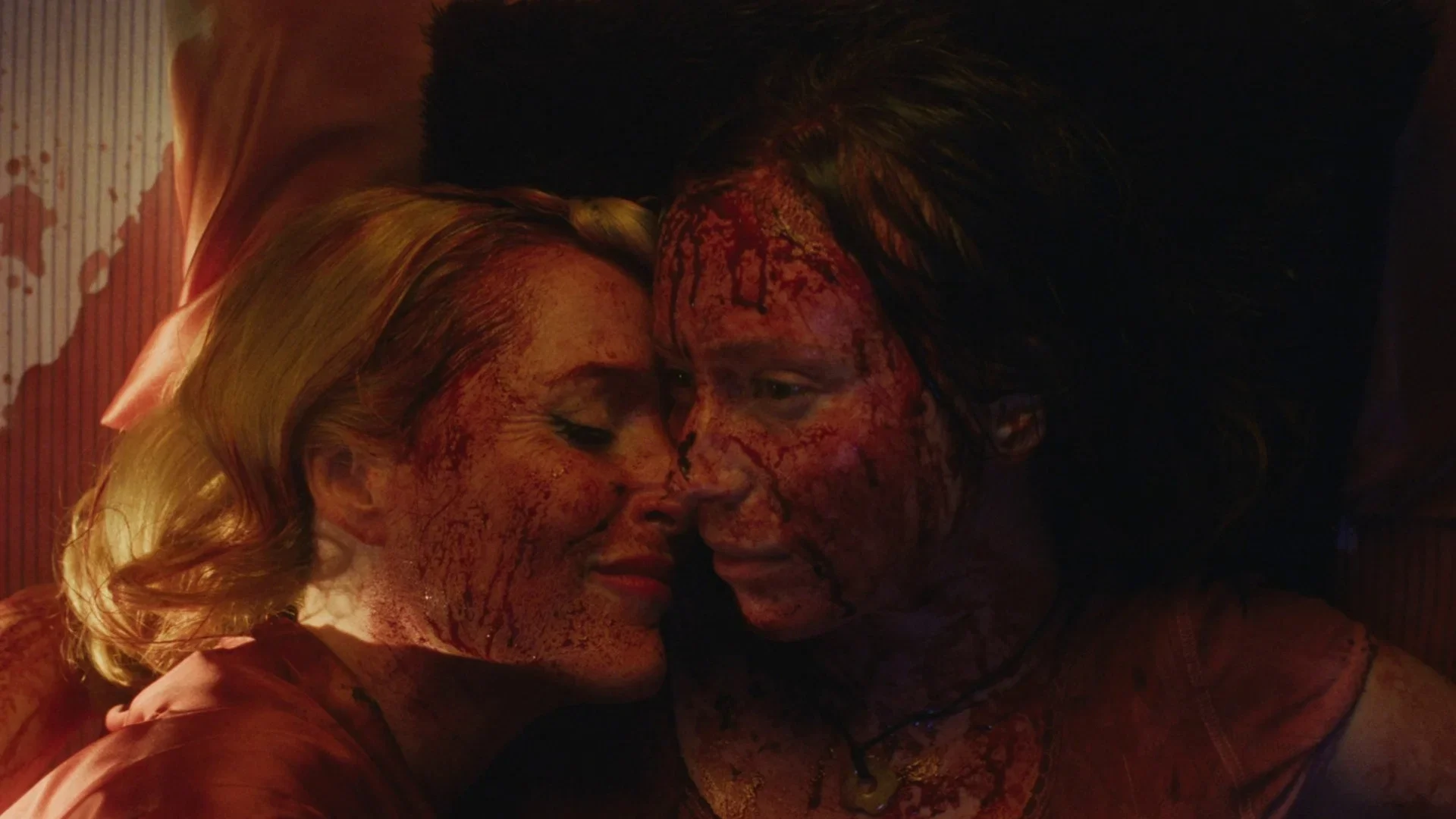
Flight from the wood leads her to Bunk 5, where Billy has been busy preparing to perform romance. Rose petals adorn a bed not big enough for the two of them, and she welcomes Kris with a hug. The two initiate another sexual encounter as Little Death grows ever closer. Billy talks Kris through it, instructing her to see herself through his eyes, bringing her closer to the climax she envisioned, and allowing her to capture that look with which she had become so obsessed. As the monster enters the bunk, Kris proclaims that she no longer wants to die, that she is not ready, but Billy assures her that she is safe. As Little Death arrives, skewering the two of them in a fashion that recalls the attack on Billy's character in the original film, Kris comes. The camera lingers on their deaths, blood oozing from their bodies and staining the bed in spectacular fashion. For a moment, it is unclear if their journey really ends here.
Teenage Sex and Death at Camp Miasma (2026) • MUBI
But morning comes and Billy was right.
The two of them revive, waking in each other's arms. Schoenbrun's camera frames the two of them, soaked in claret, wrapped in an embrace that suggests a warmth both have been longing for. In spite of the grotesque, there is beauty. Sunlight breaks through the window and the two of them settle in one of the film's most intimate images. The saturated reds are almost indecently beautiful, the violence from which they were birthed rendered inseparable from the tenderness of the moment they share.
Amid smiling faces and rubbing noses, the composition is lent an extraordinary emotional depth, as though the familiar imagery of romantic fulfilment has been reconstructed from the aftermath of a massacre. It is a delightfully perverse expression of the film's conviction that sincerity need not exist in opposition to absurdity. The slasher's excess remains gloriously intact and within the bloody world of Camp Miasma, both have found recognition and understanding and Kris finally finds the freedom to inhabit desires she had so long confined to the screen.