
Elevating The Bride’s revenge tale to the stature of myth, Tarantino’s Kill Bill: The Whole Bloody Affair spends four hours on swords, snow and slaughter to arrive at an improbable conviction: that a future beyond the violence is worth choosing.
2004 • Quentin Tarantino • 254 min • Miramax • Action
As the sirens of Ironside echo behind the eyes of Beatrix Kiddo, AKA Black Mamba, AKA The Bride, AKA Mommy, and she watches her enemies cross the frame, her bloody revenge imminently realised, Kill Bill: The Whole Bloody Affair exists as its creator intended: uncut and dripping in red.
Despite a four-hour runtime, there is scarcely a frame that Tarantino wastes on equivocation. This version of Kill Bill is a film of conviction and refuses to bloat, or sag, beneath the weight of its ambition. Tarantino’s mastery of form, composition and movement lends his signature irreverence and preoccupation with violence an air of necessity he has not come close to replicating in the years since release.
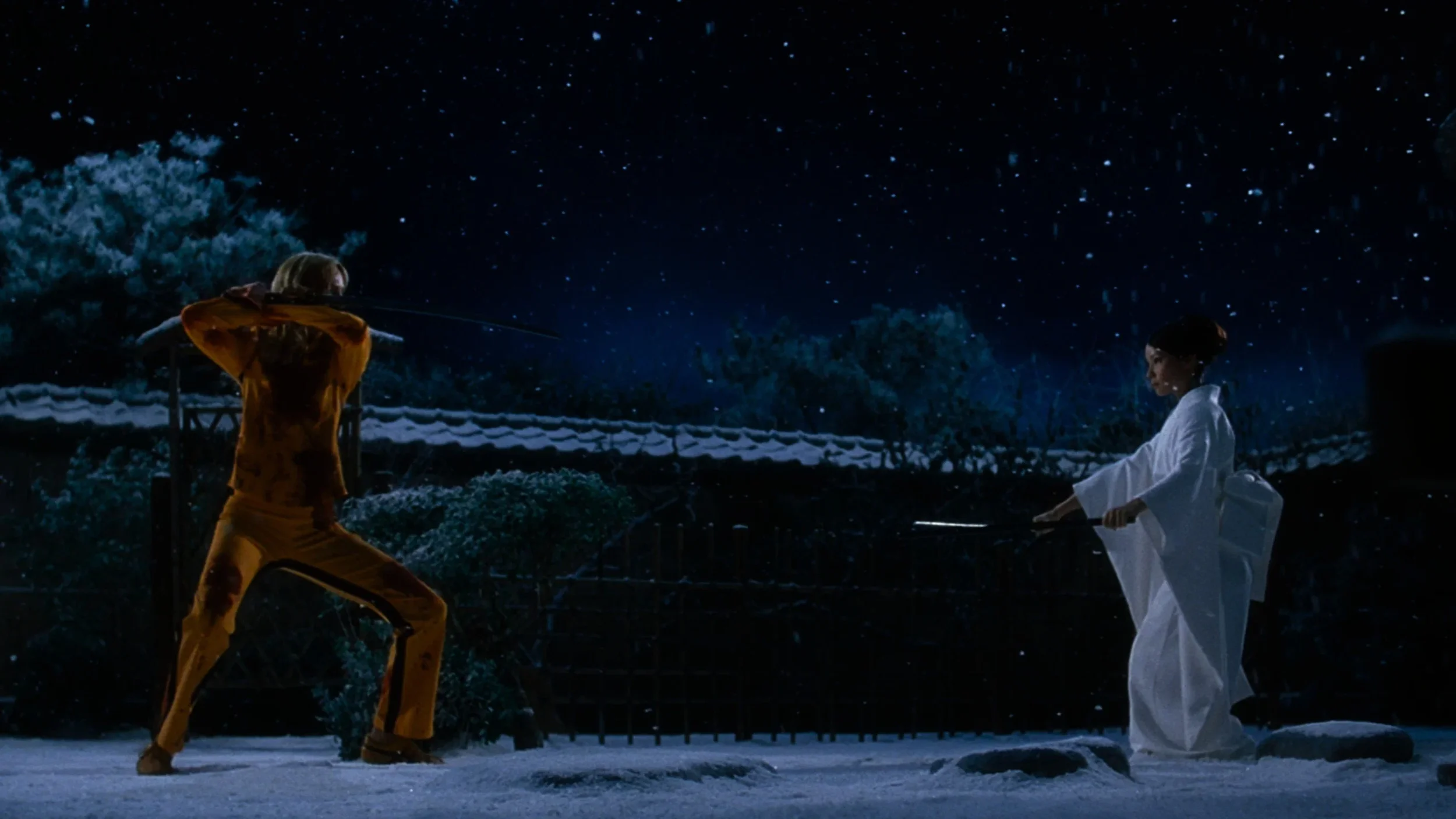
Here, even the most outrageous excess feels purposeful and every chapter leaves iconic imagery behind it: the bloodied domestic battleground shared by Beatrix and Vernita Green, AKA Copperhead, interrupted by the arrival of Vernita’s young daughter, Nikki; O-Ren Ishii, AKA Cottonmouth, standing clad in a white kimono against the snow-covered garden outside the House of Blue Leaves; Budd, AKA Sidewinder, sitting on the steps of his trailer, seemingly resigned to a fate he is aware he can no longer outrun; the black and gold of Beatrix’s Hattori Hanzo sword shimmering against the stark monochromatic palette of the night as she drives toward her final foe, Bill, AKA Snake Charmer. To these may be added any number of shots, from the yellow tracksuit to the Pussy Wagon, Daryl Hannah’s incredible performance as Elle Driver, AKA California Mountain Snake, and the extended anime sequence chronicling the history of O-Ren. Tarantino is displaying an imagination with no apparent limit and provides himself the facility to render every part of it visible.
The Whole Bloody Affair’s visual excess does more than demonstrate its director’s command of the cinematic form. He knowingly heightens Beatrix’s story into something that borders on myth, drawing upon the language of superheroes, anime, martial arts cinema and the western without ever allowing the film to become a mere collection of genre exercises. Bill’s comparison of himself to Superman, and Beatrix’s own fleeting consideration of whether she may be a superhero, are more than playful references. They speak to the legend that has grown around her, the almost supernatural figure that her enemies have come to fear.
The film’s visual language reinforces that mythology: the sudden blackout during the assault of the Crazy 88 and the blue-lit sword fight that follows, the red silhouette of Pai Mei’s training sequence, its colour and composition seemingly anticipating the bloodshed that is yet to come. These are not simply striking stylistic flourishes. They give the film the quality of a fable, in which colour, light and movement become part of the saga itself.

Kill Bill: The Whole Bloody Affair (2004) • Miramax
The choreography is no less assured. The violence is so elaborate, so impossibly precise, that it assumes the qualities of a live-action anime, embracing the absurdity and eccentricities of the genre without a flicker of self-consciousness. Gogo’s entirely unnecessary leg twirls, O-Ren’s dismissal of Charlie Brown as she stares down her enemy, the sheer theatricality of the Crazy 88: it is all gloriously ridiculous, and the film’s pleasure depends upon it.
Tarantino’s understanding of movement, however, extends well beyond the spectacle of his action sequences. Even the smallest gestures are carefully considered. As when Beatrix retrieves her knife from Vernita’s chest and climbs to her feet, thus revealing to us Nikki standing in the doorway. The choreography governs not only the action but our understanding of the space these characters inhabit. Similar precision is employed in the garden confrontation between Beatrix and O-Ren, whose mutual admiration and respect lend their final exchange an unexpected tenderness. When Beatrix asks her if she is ready, there is an almost affectionate understanding between them. Both know that only one of them will leave the garden alive.
Kill Bill: The Whole Bloody Affair (2004) • Miramax
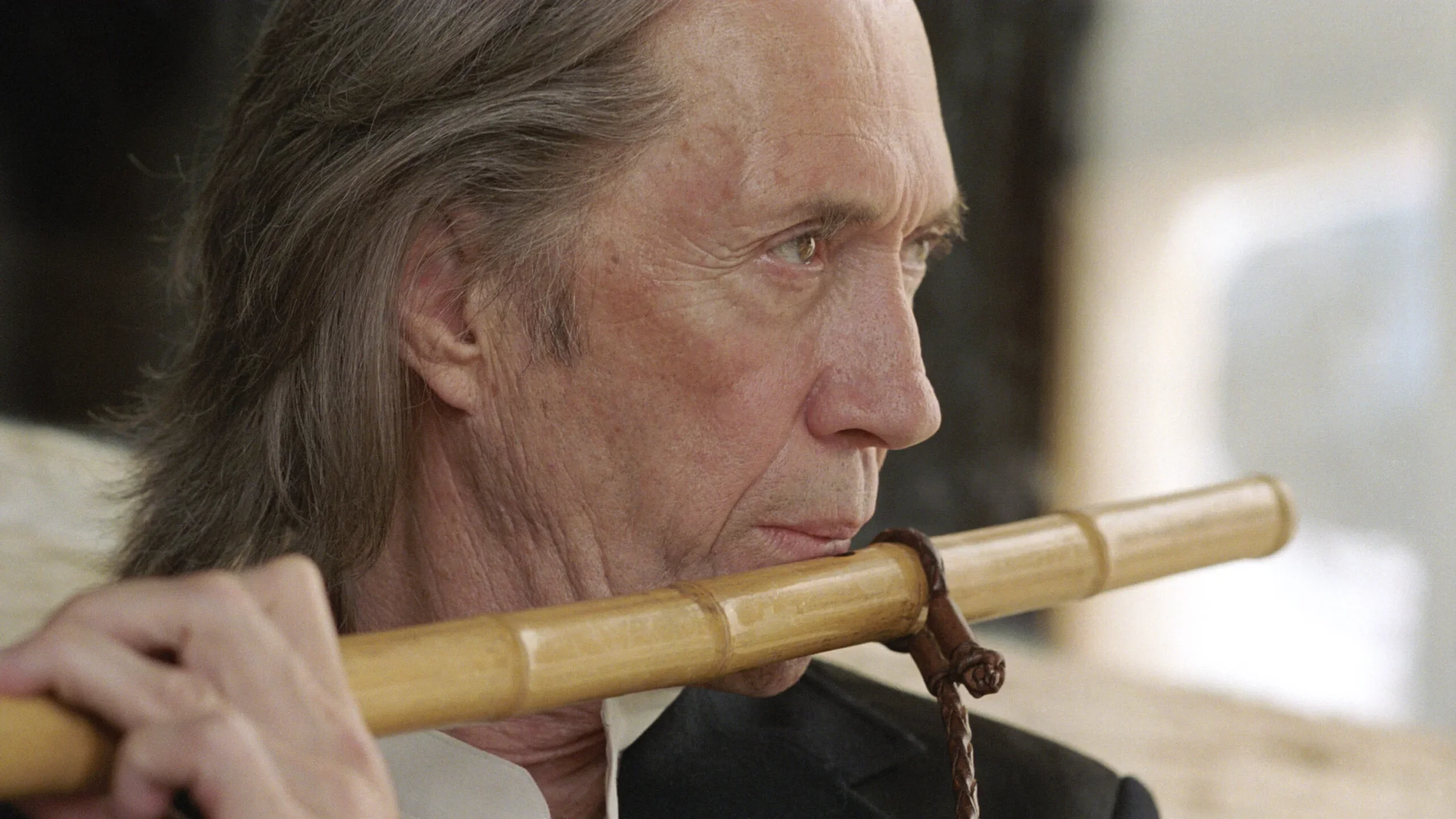
What distinguishes The Whole Bloody Affair is how little it feels indulgent. Even the extended Pai Mei sequence, which may initially appear to interrupt the momentum of Beatrix’s revenge, proves indispensable to the narrative that follows. Her escape from the grave, the history between herself and Elle Driver and the duality of their relationships with Pai Mei, the technique with which she at last undoes Bill: all acquire additional significance through what she learns there.
The same meticulous construction informs the film’s use of music, animation, colour and composition. The complete presentation does not so much improve upon an imperfect work as it reveals the full extent of what was already working. This is the fullest expression of Tarantino’s vision, and proof of his ability to bring together the many disparate influences, genres and techniques that have come to define his filmmaking.
For all its bloodletting, however, Kill Bill makes one of the most profound affirmations of life ever put to cinema.
Beatrix is under no illusions about the person she is. She knows that the lives she has taken cannot be justified, morally, and she expresses that she has derived genuine pleasure from killing. There is no absolution waiting for her at the end of this journey. She is, fundamentally, a killer. But she is also conscious of the consequences wrought by that life. When she leaves Nikki alive, she recognises that the child may one day come looking for her, just as Beatrix pursues those responsible for the destruction of her own family.
Budd understands this too and, when we finally meet him, he seems at peace with the possibility that his time is nearly up. He tells Bill that, for what they have done, they deserve to die. There is an uncomfortable self-awareness in him that mirrors Beatrix, a recognition that a cycle of violence does not end simply because its perpetrators have been punished.
Kill Bill: The Whole Bloody Affair (2004) • Miramax
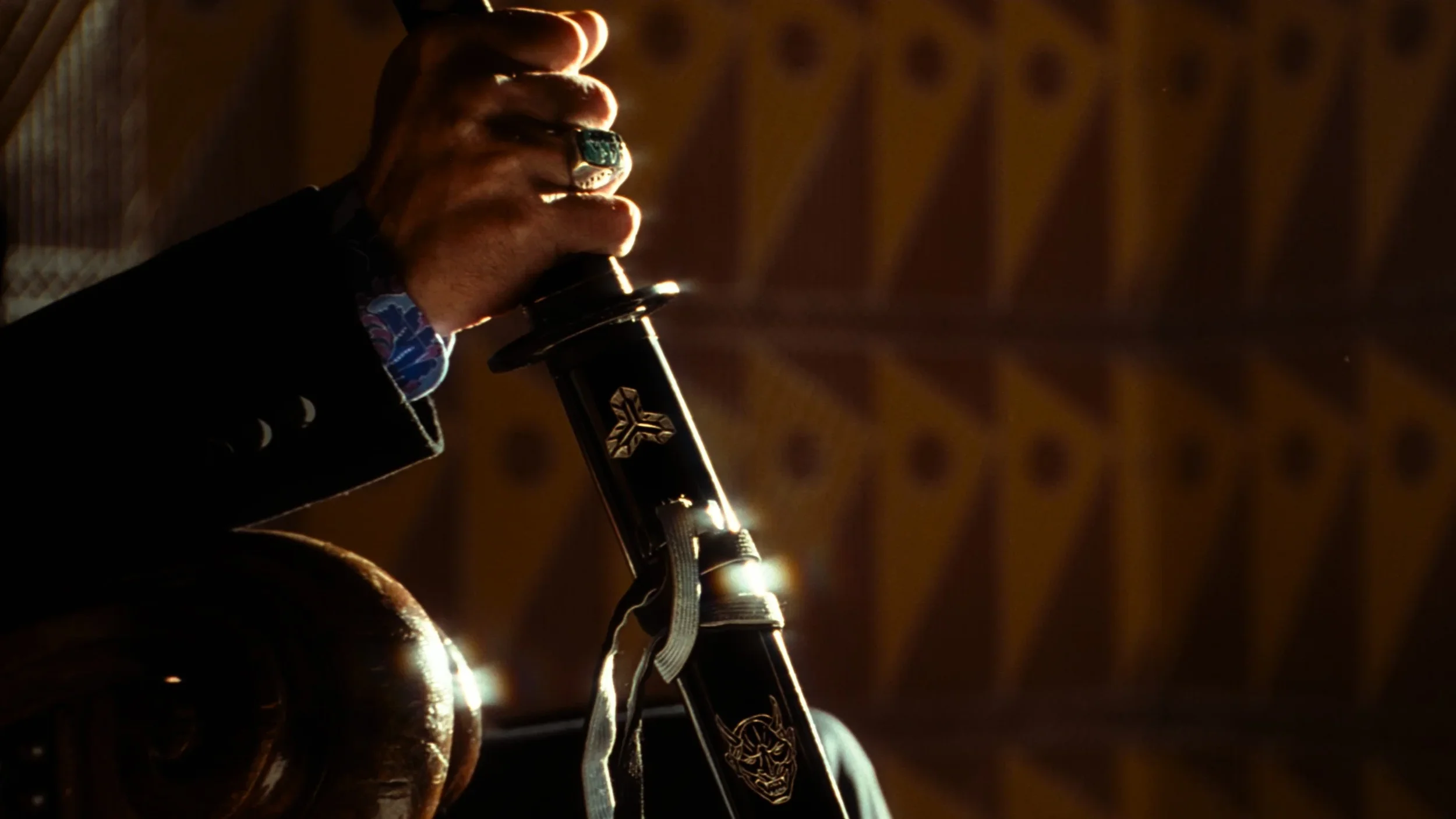
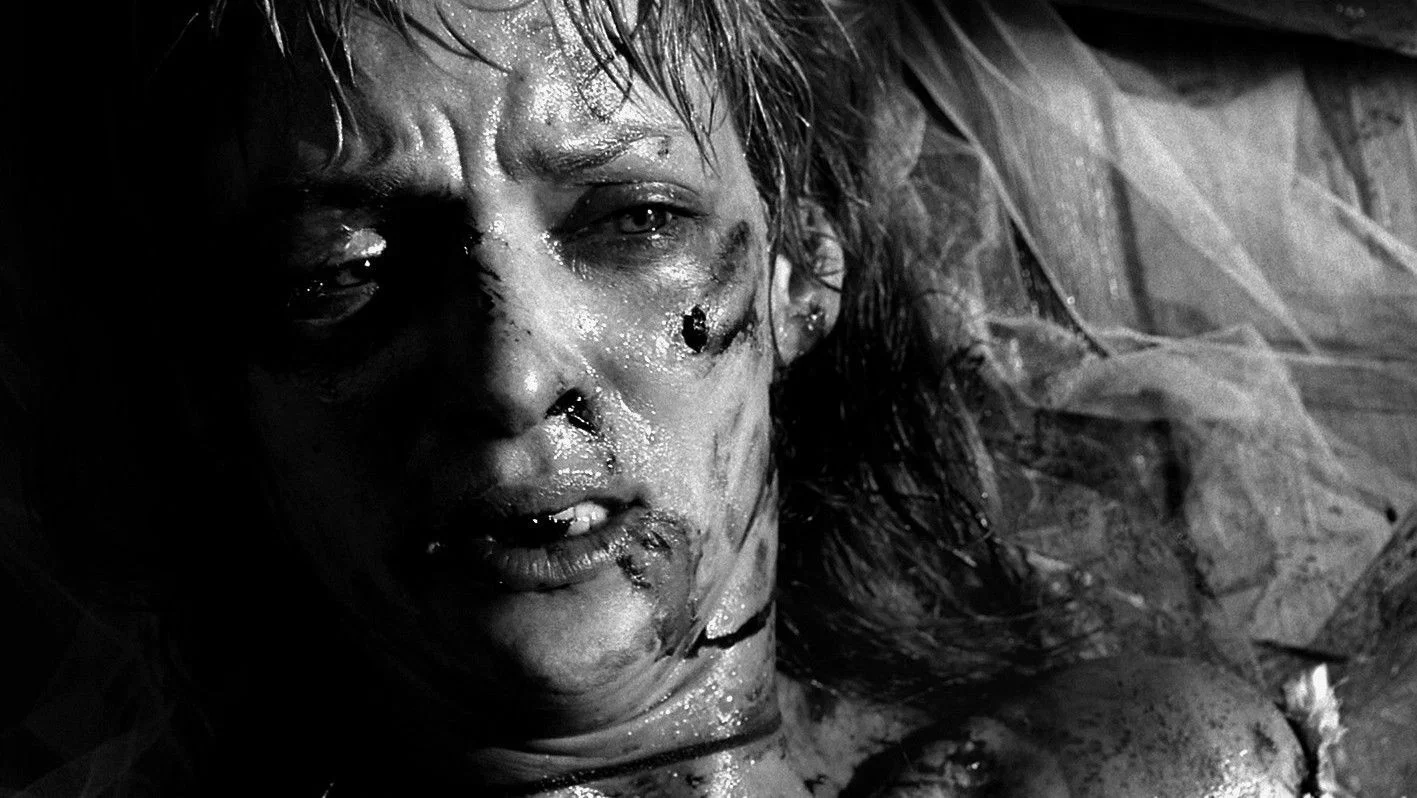
The origins of Beatrix’s pursuit lie in a more fundamental violation. Throughout the first half of the film, we only ever see glimpses of Bill. He is presented almost entirely through the control he exercises over others. He is present in the consequences of his actions long before his physical reveal: Beatrix lying on the chapel floor, his hand dabbing blood from her temples, Elle receiving his instructions via telephone, his hand gripping the hilt of his katana as he calls off the hit. When he finally appears, he is once again arranging the circumstances around Beatrix. He inserts himself into her wedding rehearsal, exploiting the invitation she extends to him, and takes B.B. away from her.
The successful appropriation of his daughter is, perhaps, Bill’s greatest accomplishment and ensures that the final confrontation with the mother of his child will take place on his terms. The truth serum, the location and their conversation have all been carefully orchestrated. His control is not merely an expression of his jealousy, or his pride. Instead, it is an assertion of an authority he believes he has, and is entitled to, over Beatrix’s life. He cannot accept that Beatrix has the right to choose a future beyond him.
Her pregnancy was the moment that choice first became, to her, unavoidable. As she explains to Bill, before the pregnancy test turned blue she was his woman: a killer who would have jumped a motorcycle onto a speeding train for him. But once it turned blue, she could no longer be that person. She was going to be a mother. Beatrix does not pretend that the decision to leave her life with Bill behind makes her innocent, nor does she deny that she enjoyed the very life they were living. But she understood that it was not a life in which she could raise her daughter. Because, from the second she was born, she would be his.
Bill’s refusal to accept her decision, and the violence that followed, are the consequences of a man interfering with a woman’s right to determine the course of her own life and the future of her body.
Kill Bill: The Whole Bloody Affair (2004) • Miramax
The revelation that B.B. is alive forces Beatrix to confront the choice she made four years earlier. Until the moment she walks through the garden doors of Bill’s villa, her journey has been one of revenge and she has been consumed by it, almost at any cost. But when she sees the two of them together, the purpose of that journey is transformed. Beatrix, in that moment, is confronted with the possibility of the life she originally chose to protect, and the responsibility that comes with it. She does not need to become an entirely different person to understand that her daughter deserves something better. Therefore her victory is not that she has somehow redeemed herself, but that she has finally reclaimed the prospect of a life beyond the violence that has defined her.
Even Bill’s death is not quite the unambiguous surrender of control that it may first appear to be. His heart will only explode after he takes five steps, leaving him to determine the precise moment of his own death. His final question feels like an adjustment before a curtain call, a swan song that he will deliver on his own terms.
When Bill cannot control something, he argues against it. His interrogation of Beatrix as to why she never told him she knew the Five Point Palm Exploding Heart Technique is revealing: even now, he feels entitled to whatever she has chosen to keep from him. She can kill Bill, but she cannot make him relinquish the belief that he was entitled to control her. His death ends his power to act upon that belief, yes, but it does not erase it.
When the dust finally settles, and Beatrix finds herself alone on the bathroom floor, the tears that follow are complex ones. There is likely grief for Bill, for the man she once loved and for whom she would have done anything; for Tommy, the wedding and the life that might have been; and for the four years she has lost with her daughter. There is, perhaps, even grief for the person she once was and the world that she relished inhabiting, however bloody its foundation. But there is relief, too, and possibility.
The possibility that, with Bill and the Deadly Viper Assassination Squad gone, she and B.B. might finally be safe. After four hours of bloodshed, Tarantino arrives at an image of almost disarming intimacy: a mother, overwhelmed by everything she has lost and everything she has regained, finally able to cry. For a moment, she is allowed some semblance of normality.
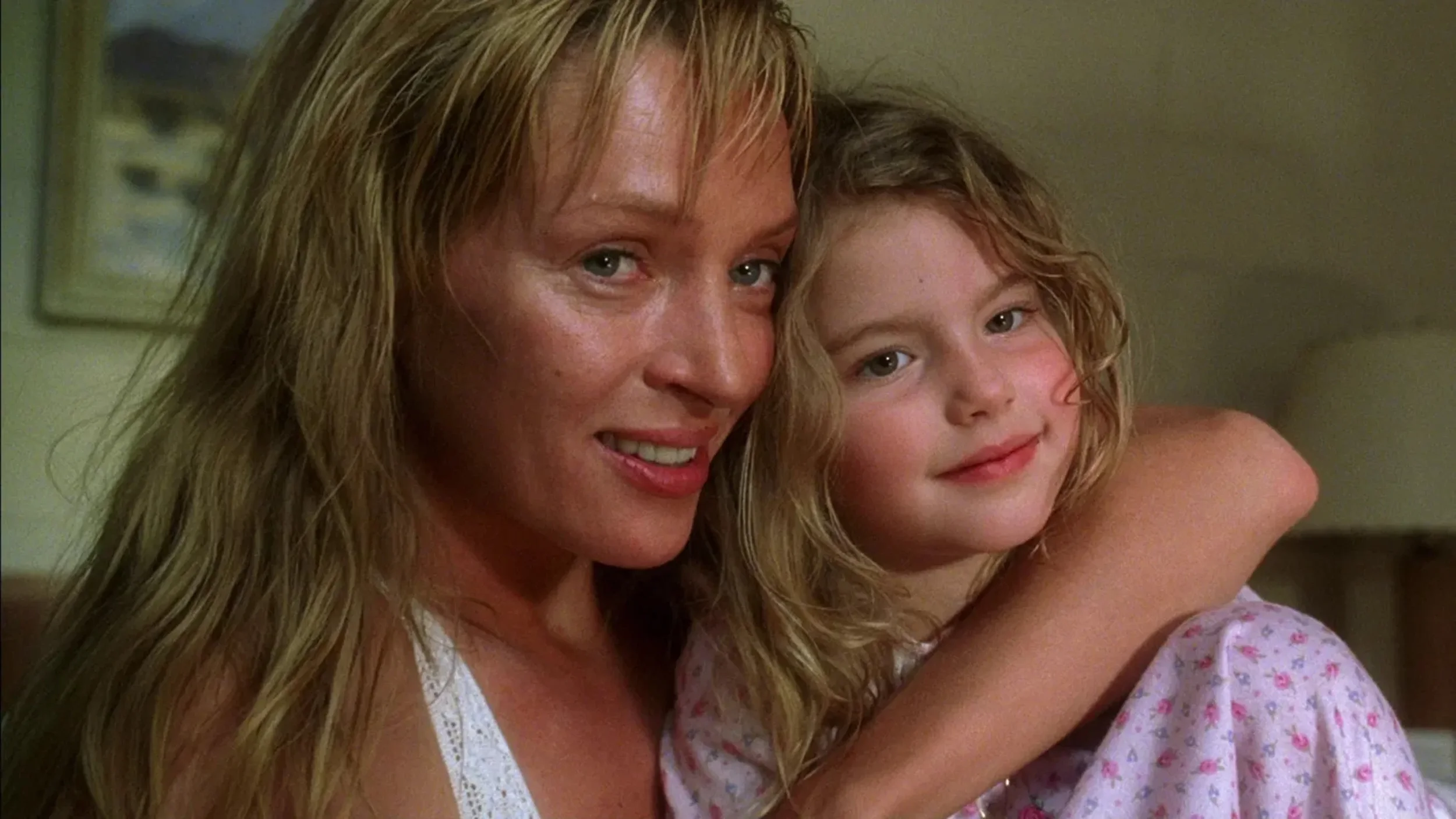
Kill Bill: The Whole Bloody Affair (2004) • Miramax
The film’s final image rests on Beatrix and B.B. together on the bed, watching cartoons and laughing, offering something the film has withheld from them both: the chance at leading an ordinary, domestic life. Neither can return to the world they knew. Beatrix has left behind the life of a killer and B.B. has lost the father and the privileged existence she shared with him. Whether they will survive that which awaits them remains uncertain, but they are together, and the future is finally theirs to determine. The Lucky Charms across the room, a small echo of Vernita and her own four-year-old daughter, brings the story quietly full circle. The child who once witnessed the consequences of her mother’s violence is mirrored by another child who may yet be spared them. It is a wonderfully ordinary detail that carries extraordinary resonance.
For all its intrepidity, Kill Bill is a ravishing picture concerned with the lengths we will go to for our children, and the right to decide what kind of life we want to live. Its final triumph is not that Beatrix has worked through every name on her list, but that she and B.B. might now have the chance to build something beyond the world Bill made for them. The spectacle of revenge recedes. What remains? The promise of a future.