
In a masterpiece of extraordinary tenderness that affords childhood an almost limitless capacity for wonder without retreating from its uncertainties, Miyazaki imbues Totoro with a reverence that allows the smallest moments to become magnificent and finds, in the ordinary business of living, a beauty worthy of cinema’s greatest imaginings.
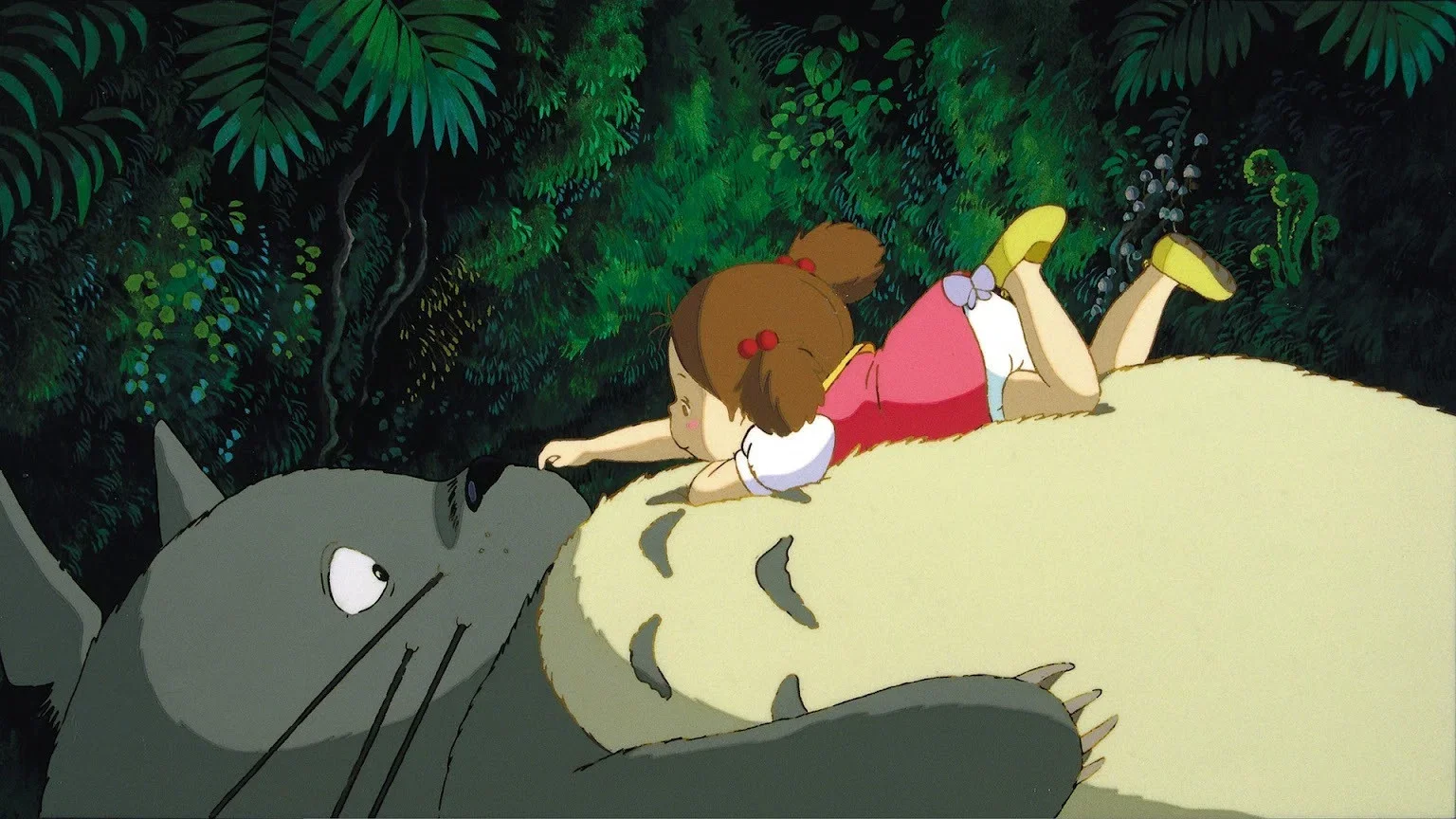
1988 • Hayao Miyazaki • 86 min • Studio Ghibli • Animation / Fantasy
An old house, a country road and two sisters convinced that every unexplored corner might conceal a secret. Hayao Miyazaki's My Neighbor Totoro establishes its world through the inexhaustible curiosity of Satsuki and Mei, whose arrival in the Japanese countryside transforms the ordinary business of moving house into something more akin to adventure. Together, they float through Miyazaki's gorgeous landscapes with a delight so utterly sincere that even the creaking walls of their new home become an invitation. The loveliness of this film is, in part, because it is less concerned with the concept of what comes next than it is the pleasure of being here at all.
Miyazaki affords childhood an extraordinary generosity, resisting the temptation to impose the conventions of traditional storytelling upon the lives of his characters. There is no antagonist to overcome, no great quest upon which the sisters must embark, and little interest in contriving conflict merely to precipitate resolution. Instead, the film unfolds as an exploration of a particular moment in this family's life, finding its drama in the experiences that constitute it. There is laughter, happiness, stillness and worry; the familiar rhythms of an existence that requires no further justification to be considered worthy of our attention. In dispensing with much of the machinery of conventional narrative, Miyazaki discovers an almost limitless capacity for finding wonder amid the ordinary.
That sensibility is apparent in the animation itself. Much of the film's visual splendour derives from the remarkable stillness of his complex compositions and characters moving through exquisitely painted landscapes. It is refreshing that the countryside does not constantly reorganise itself around Satsuki and Mei; its fields, trees and winding paths possess an existence independent of their adventures, yet these are images that are never lifeless. As the wind passes through the grass, leaves rustle overhead and the changing weather lends this natural world a personality entirely its own. Miyazaki's approach to animation is almost benevolent. Rich. And we are able to sit alongside a camera that settles somewhere amid the country watching the two sisters, permitted to play and to discover, without there ever being an insistence that the world they inhabit exists solely to accommodate their discoveries.
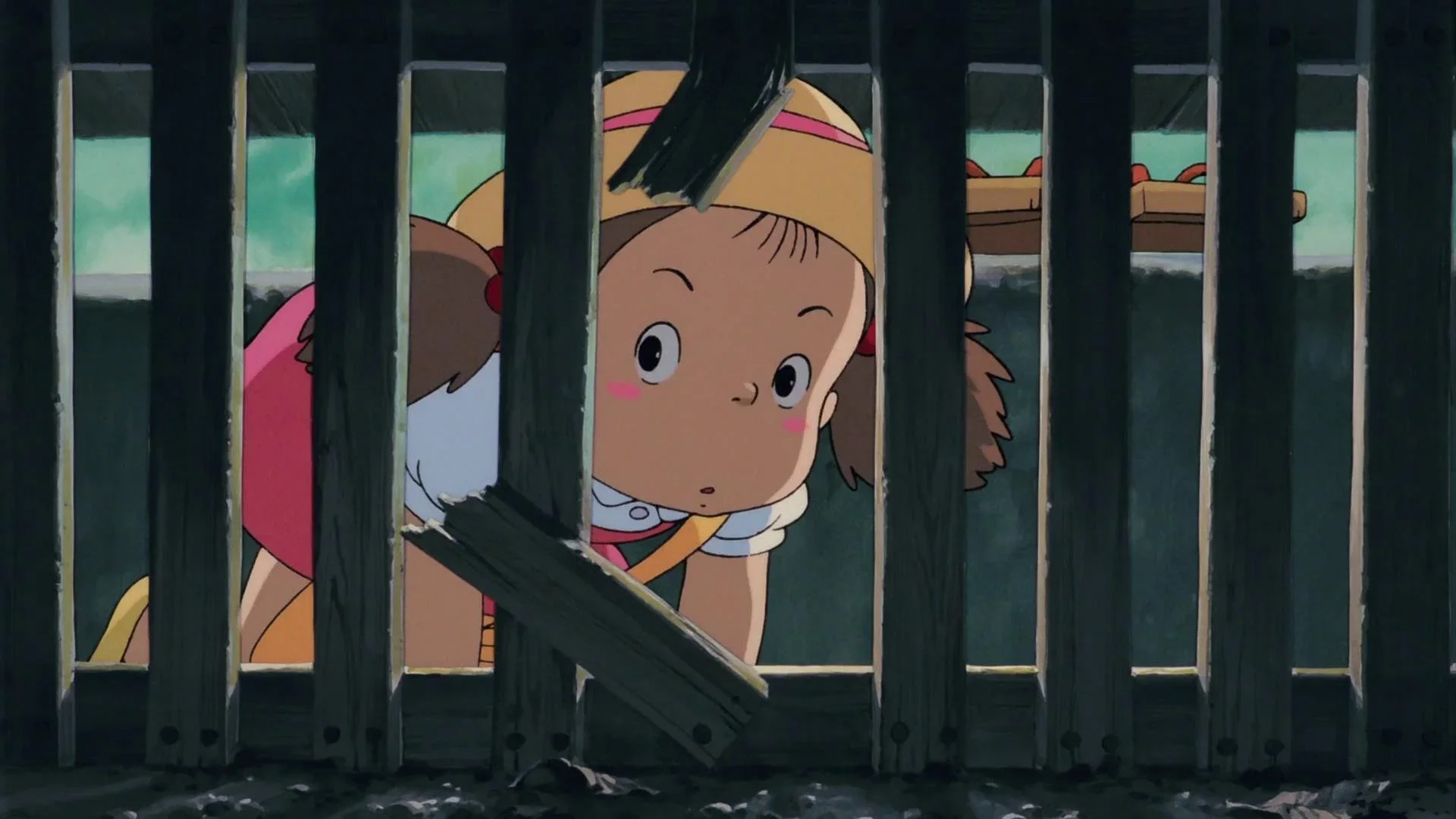
My Neighbor Totoro (1988) • Studio Ghibli
The girls embrace the mysteries of their new home with an enthusiasm that makes the unravelling of the unfamiliar practically irresistible. They race around the homestead, giggling and imitating one another as they uncover the existence of the soot sprites concealed within its walls. The mystical gremlins retreat into unreachable crevices, but the girls press on, and their companionship lends courage to their curiosity. Crucially, their imaginations are afforded remarkable consideration by the adults surrounding them. Each encounter is one of affirmation; nobody demands that the girls abandon imagination in pursuit of some more acceptable reality. Their experiences, however fantastical, are treated with the seriousness they deserve. For example, when Mei recounts her first encounter with Totoro, her father does not dismiss the possibility of a woodland spirit, but suggests that the creature might be the keeper of the forest; Granny recalls the soot sprites from her own childhood, and the family's relationship with the natural world is characterised by an almost reverential affection.
The film's refusal to establish an absolute distinction between fantasy and experience has, inarguably, done wonders for Totoro and its legacy. Since its release in 1988, Totoro has become inseparable from Studio Ghibli's identity, its woodland spirit immortalised as the studio's mascot and its unhurried celebration of childhood securing the film a place within the canon of world cinema. To package childhood and all its wonder, without retreating into self-seriousness or trying to establish the truth of the girls' adventures beyond a reasonable doubt, is a remarkable feat that has enabled it to stand the test of time and find its way into the hearts of many. It is especially enjoyable to watch as their delight survives even their own uncertainty, and the willingness of the adults to encourage their commitment to belief in their discoveries enables Miyazaki to portray an environment in which the imagination of a child can and should flourish without falling under threat of ridicule. The world Satsuki and Mei inhabit is as magical as they understand it to be, whether or not anybody else sees it.
But despite the immaculate, enduring vision of childhood that is presented in Totoro and punctuated primarily by joy, it is not an idyll entirely untroubled. The girls' mother remains in hospital, her illness having precipitated the family's move to the countryside, and the uncertainty of her recovery coexists as they uncover one adventure after another. Satsuki writes letters, the sisters visit whenever they can, and their affection for their mother is never in doubt. Neither is their capacity to find happiness in the meantime. Miyazaki permits these two realities to coexist without allowing one to diminish the other and the understanding that happiness need not be dependent upon the absence of suffering leaves Totoro all the better for it; even in circumstances of considerable uncertainty, the simple pleasure of living remains.
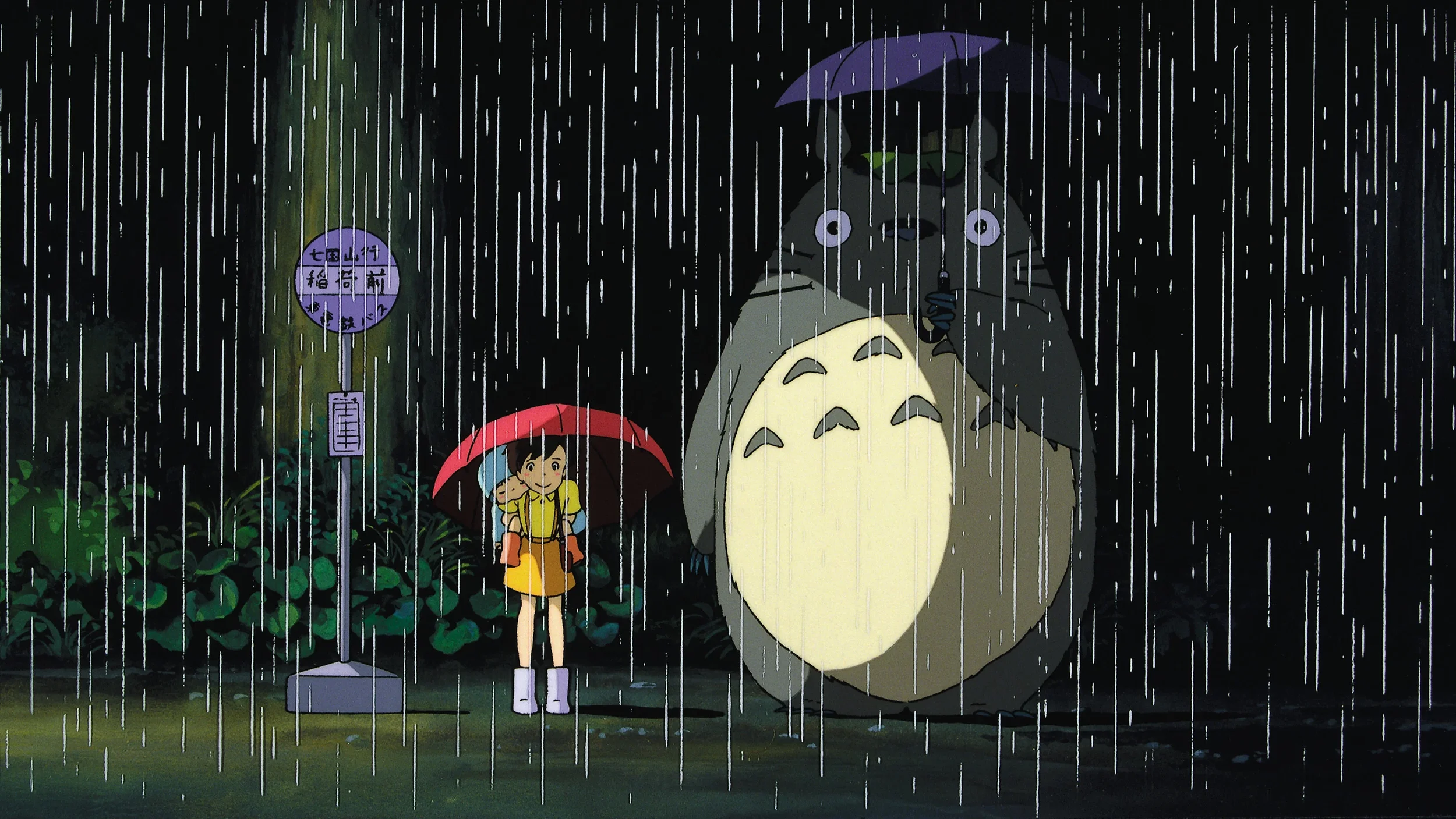
My Neighbor Totoro (1988) • Studio Ghibli
Perhaps nowhere is this more beautifully expressed than in the sequence at the bus stop. Darkness surrounds the sisters as they await the arrival of their father beneath the falling rain, and the scene that unfolds possesses a mesmerising patience. When Totoro appears, Miyazaki's attention settles upon the creature's enormous eyes, his ears almost protruding through the canvas of the umbrella that Satsuki offers him. The sound of raindrops striking its surface produces an expression of ecstatic glee, before a tremendous bound sends water cascading from the branches overhead. There is something wonderfully absurd about a creature of such fantastical proportions finding so much pleasure in the rainfall. But his roars of excitement are not what gives this sequence its power. Instead, it is the quiet. It is the darkness, the gentle rhythm of the rain, the stillness that is interrupted by Totoro's sudden movement. When the catbus eventually arrives, the exuberance with which it travels across the landscape momentarily disturbs the scene's measured composure and transforms it into something fantastically energetic. Then, almost as quickly as they appeared, Totoro and the bus are gone, bounding over the hills and into the night beyond. This encounter with the extraordinary unfolds with a beauty that need not advance the narrative; its significance is in the experience of the encounter itself.
The relationship between the sisters gives these otherwise disparate experiences their emotional continuity. Satsuki, as the eldest, assumes a responsibility for Mei that sometimes threatens to overwhelm her own childhood, but she does not permit that responsibility the power to override a shared adventure. Their affection, as anyone with a sibling is aware, is not without frustration, and when news of their mother's delayed return provokes an argument, the emotional strain of their circumstances becomes painfully apparent. Satsuki's exasperation is born of the same fear that leaves Mei distraught, but neither possesses the means to adequately express it. There is an extraordinary naturalism to their relationship, their affection no less profound for the moments in which they become impatient with one another; they fight because they are sisters, and because the people we love are not exempt from our frustrations. Especially when those frustrations are impossible to separate from the possibility of loss.
Subsequently, Satsuki is faced with the prospect of Mei's disappearance. Given Miyazaki's establishment of their relationship and the fact that, even in a world of limitless wonder, we are not exempt from frustration, this is therefore a natural escalation of the film's emotional concerns as opposed to a sudden concession with realising some conventional dramatic structure. The countryside, once infinitely inviting and safe in the comfort of its devastating beauty, becomes a landscape through which Satsuki races in mounting terror, the prospect of losing Mei made almost unbearable by a guilt that has manifested in the wake of their earlier argument. The urgency of her search is palpable, and Miyazaki's capacity for communicating emotion through movement becomes devastatingly apparent. Where the girls once moved together through this world of inexhaustible possibility, they are both faced with the confrontation of that enormity alone. Satsuki's determination is not merely an expression of her responsibility, but of a love of such unbridled profundity. When she finally finds Totoro and implores him for help, the mystical world that has been the connective tissue through which the sisters shared their adventures becomes the very means through which they are to be reunited.
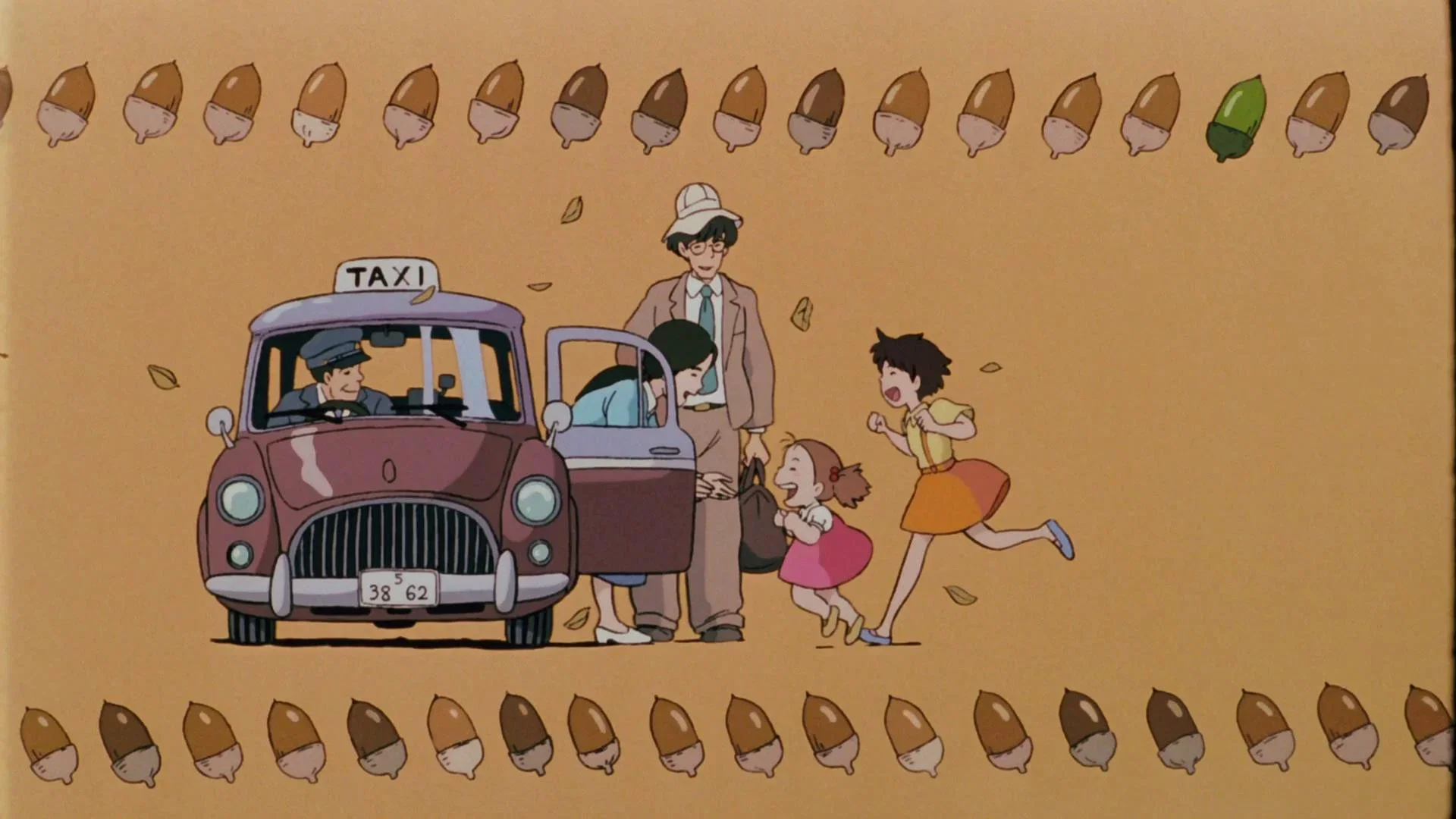
My Neighbor Totoro (1988) • Studio Ghibli
The essential arcadia of Totoro is not predicated upon ignorance of life's uncertainties; innocence does not fade simply because the world can be frightening. Happiness is sometimes interrupted by worry, and even the most profound expressions of love cannot protect us from the possibility of loss. Yet Miyazaki understands that suffering has no greater claim upon our attention than the innumerable pleasures that accompany it. His confidence in animation, and in cinema's capacity to discover meaning without imposing grand dramatic consequence, allows the smallest moments to become magnificent: the sound of rain upon an umbrella, the rustling of leaves, the embrace of two sisters reunited. In My Neighbor Totoro, the extraordinary does not displace the ordinary. The two inhabit the same world, and in their coexistence we discover perfection.