
Stanley Kubrick’s Eyes Wide Shut invites us across the threshold of a marriage and into a night of masks and trespass, binding the viewer to Bill’s curiosity until the film withdraws its welcome and leaves its final disclosure to the Harfords alone.
1999 • Stanley Kubrick • 159 min • Warner Brothers • Thriller
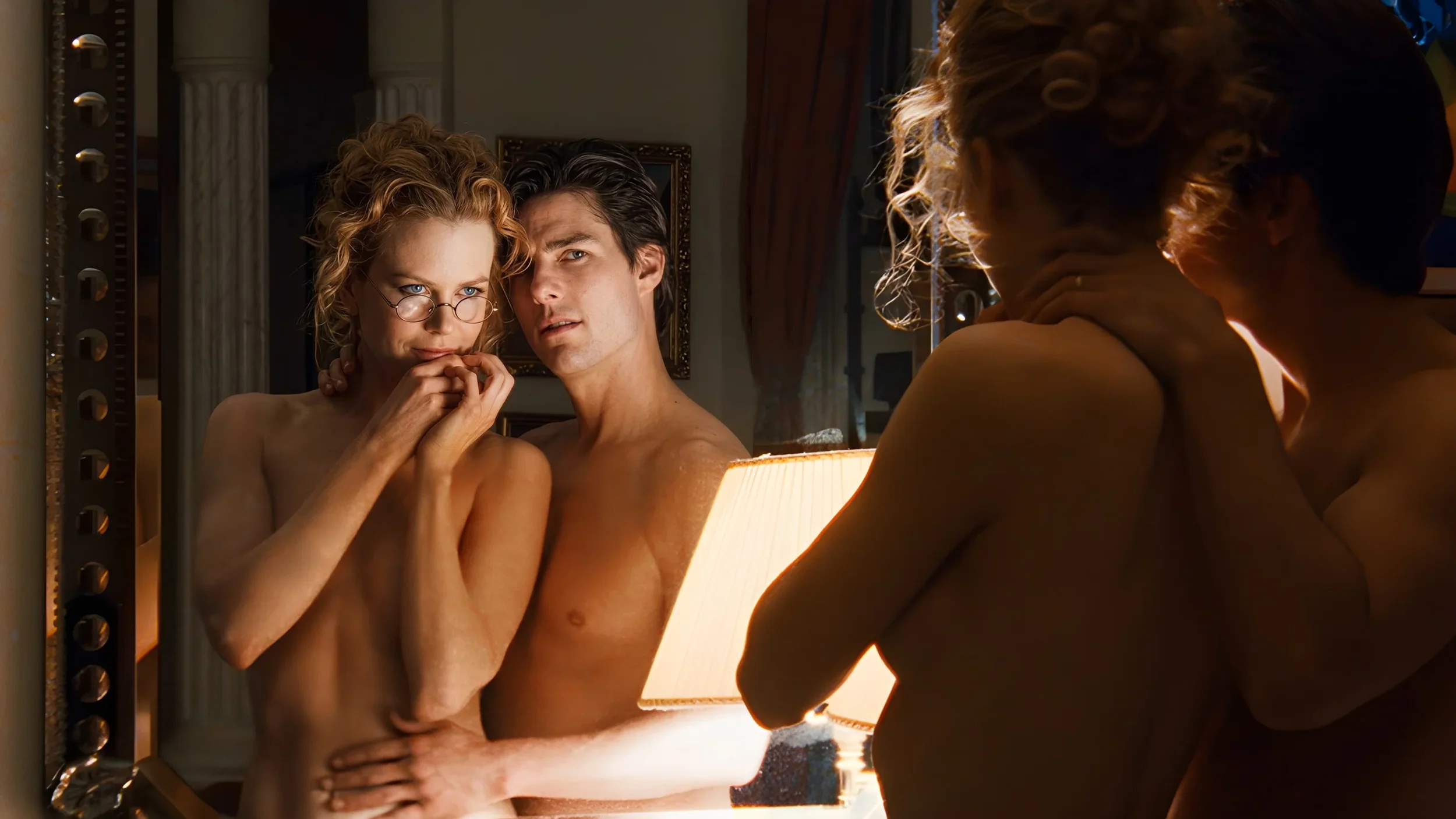
After its opening image of Nicole Kidman’s Alice undressed, Kubrick’s final film introduces the Harfords in the apartment they share, the camera positioned at the thresholds of the rooms they occupy, the two of them doused in the warm light of their home as they prepare to leave for a party. That opening image has already invited us into a world to which we do not belong and begun asking us to look, before we know whom it is we are looking at.
Bill and Alice are a couple intimately familiar with one another; she urinates in front of her husband as he adjusts his tie in the bathroom mirror, then she asks for his assistance securing her dress. The first, and perhaps only, moment of clarity that Kubrick offers occurs within this bathroom: there is almost nothing these two individuals do not share.
Despite the reassuring domesticity of these moments, punctuated by playful exchanges and familiar movements, with their daughter Helena at home under a babysitter’s charge, Kubrick’s camera maintains a curious distance, observing the couple from doorways. He entices us into the domain of shared intimacy, but he does not fully allow us to inhabit it.
That partial welcome is where the seduction of Eyes Wide Shut begins. The Harford home is presented as a place of safety, but it is the worlds outside of it (the party, the streets of New York, the jazz café and, eventually, Somerton) that produce the tension and escalating dread that pervade the night. The golden warmth of the shared rooms in the Harford household is set against the uncertainty that lies beyond them.
Bill operates with a confidence that is grounded in the assumption that he understands the boundaries of his marriage, and the belief that those boundaries are shared, but Alice soon makes a confession that not only threatens to dismantle that understanding but also the marriage that it supports.
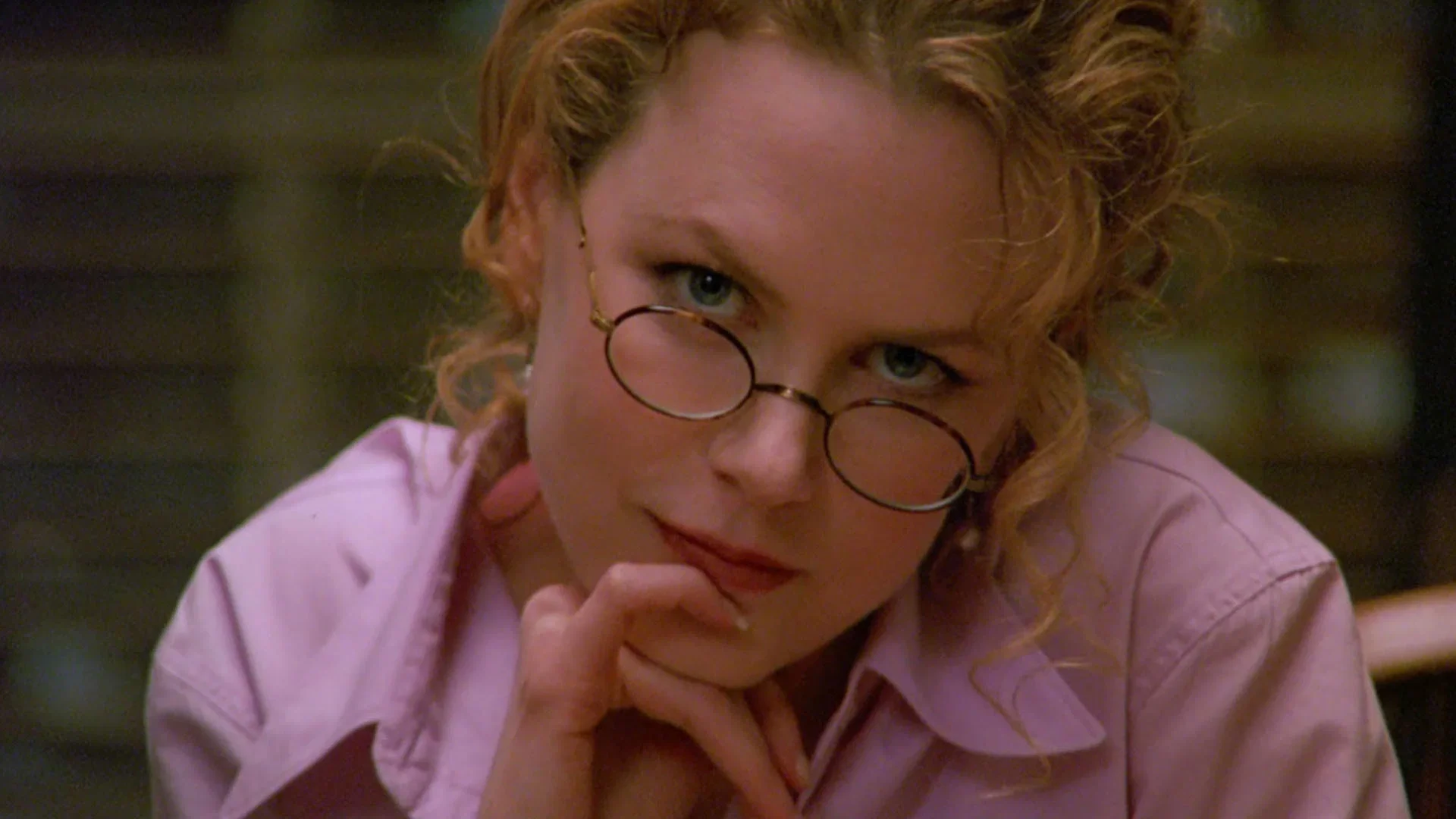
Though the bathroom glowed, it is in the bedroom that the warmth begins to drain from their home. There, a day after the party, Alice describes a sexual fantasy and, for a fleeting moment, the willingness to leave her entire life behind for the mere possibility of a night with a man she never even knew. After almost a decade of marriage, she misses the sensation that accompanies being seen. The feeling of desire. Of being wanted. Bill has mistaken familiarity for knowledge of the person that his wife has grown into, and he appears to have taken the security of their marriage as an assurance that there is nothing left for either of them to discover in one another.
To be loved is to be considered.
Bill’s failure lies not in the fact that he does not love Alice, but in the fact that he has reached a place where he has enabled himself to allow the apparent stability of their shared life to obscure the complexities of the person with whom he shares his bed.
Eyes Wide Shut (1999) • Warner Brothers
Alice’s confession exposes an assumption he has barely recognised: that he can understand her sexuality simply by virtue of being her husband. She knows herself to be a sexual being, a woman in touch with desire, who enjoys the thrill of being seen. The party sequence demonstrates this perfectly; she spends time in the arms of a man whose name she does not know, flirting unrepentantly, while Bill disappears from view. She enjoys the dance, fully inhabiting parts of herself she has left unexpressed in the company of her husband, and although Bill becomes aware of their tryst, he has not yet considered what it means. When she speaks to him of her desire, she gives voice to something that has existed beyond the realm of his knowledge and, more importantly, his control.
Yet Eyes Wide Shut imparts upon Alice a less than straightforward treatment. Kubrick’s film holds her at arm’s length, using her to reiterate the sensuality bubbling beneath the film’s surface. Even while simply getting ready for the day ahead, or brushing her teeth, Alice is sexualised. That is because, outside of her admission, the film insists upon understanding her through the gaze of others. Whether it is Bill, Ziegler, Nick, or Sandor, she is presented almost exclusively how she is perceived by those, particularly the men, that surround her.
Her desires, similarly, are never realised by Alice herself. There is no conventional image of that which she describes. It is heard, not pictured; when we see her with the naval officer it is an emergence of Bill’s imagination, his subconscious replaying the images of them entwined as Jocelyn Pook’s sepulchral score buries them in bedsheets. Instead of a reconstruction of the experience she imagined, Alice is allowed only the authority of speech and, while it is clear Kubrick recognises the complexity of this woman and her capacity for carnality, he does not grant us a visual outside of what it provokes in Bill.
Her revelation fundamentally alters the terms of the Harfords’ marriage. Bill cannot plausibly return to the certainty he possessed before hearing it, and his subsequent journey through the city becomes a desperate exercise in making sense of a desire he has not acknowledged within himself.
Where the camera once halted at the thresholds of the Harfords’ rooms, it now follows him through doorways, around corners and into the unfamiliar, often without the reassurance of a cut. We flank him, sharing in the uncertainty about what lies over the next threshold, what lurks behind the closed doors. At Ziegler’s party, Tom Cruise lends Bill a self-satisfied ease that shades into something faintly forbidding; as the night progresses, his jealousy and his wounded pride begin to expose the arrogance simmering beneath it. Bill is not an especially sympathetic figure, and the consequences of his actions are repeatedly brought to his attention by those around him. Even so, the desire to follow remains irresistible. Eyes Wide's seduction is complete: we want to look.
As long as Bill is welcome, so are we. His status as a doctor constantly opens doors, even if the film suggests that such doors should remain shut, and his money buys him access. The confidence he exhibits allows him to navigate encounters that may otherwise put an end to his nocturnal activities, but he remains able to move through the dreamscape of New York with the assurance of a man who believes the world and the places within it are, to some extent, available to him.
Eyes Wide Shut (1999) • Warner Brothers
Somerton, however, the stately home that stands against the backdrop of the night and is lit to suggest a secret as illustrious as it is devastating, is not one of these places. The camera is positioned in the passenger seat of the taxi that delivers Bill to the estate’s gates; we are his passengers, accompanying his journey into a world where he does not belong. Dread begins as he exits the vehicle. Here, his familiar advantages fail. He can pay for the journey, acquire the costume and repeat the password, but none of these things provides him legitimacy.
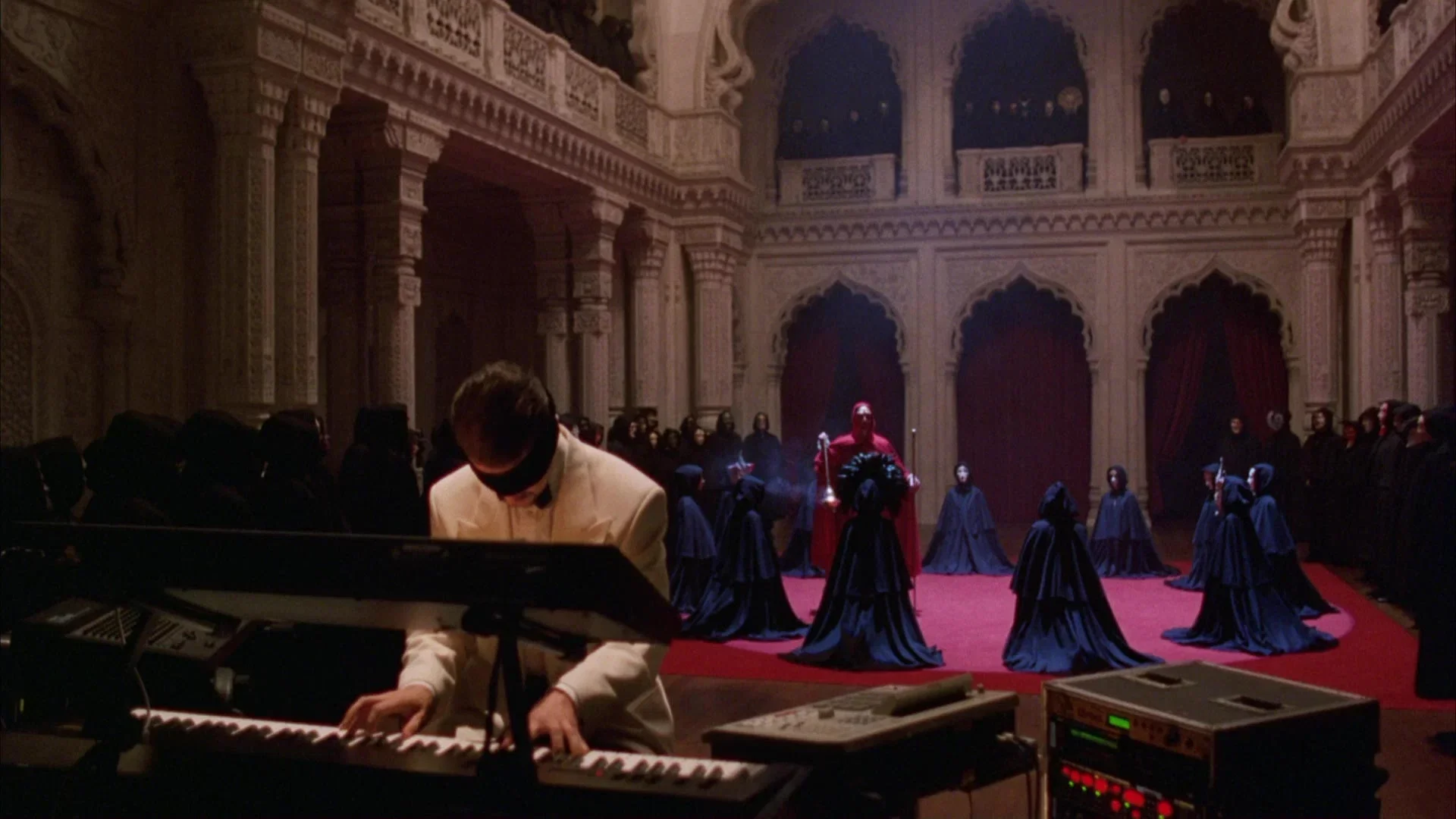
The masked gathering at Somerton is the culmination of the film’s initial invitation. Those around Bill are concealed, their appearances offering no assurance of identity, and the voyeurism of Eyes Wide Shut comes into frightening focus. Watching has become inseparable from the possibility of being watched and, despite the warnings he has received and the danger that surrounds his pianist friend Nick Nightingale, Bill is aware that the people gathered in this place possess a power beyond what he is able to comprehend.
The ritual makes that power undeniable.
The camera circles Bill as he is summoned into a room where he is at once intruder and occasion. He is now firmly in a world that he cannot recognise, a place whose inhabitants understand the terms of his presence far better than he does. The walls are lined with figures in increasingly elaborate masks and the film takes the time to examine all of them. The camera lingers on the sinister audience, whose identities and expressions are concealed from Bill and viewer alike. Pook’s clawing score climbs toward crescendo and we understand through Kubrick’s shots that these people are rejecting him despite the fact that the very thing that makes them human remains impenetrable. They are gathered, assembled especially for him, at the behest of a leader drenched in red and seated atop a throne. The staging carries a ritualistic gravity against which Fidelio, offered by Bill as both credential and plea for clemency, counts for nothing.
The secrecy of his infiltration is exposed when he is ordered to remove his mask. The cloak and dagger of the evening gives way to something considerably more disquieting: he has been discovered. Until now, Kubrick has asked us to follow Bill willingly, sharing in his curiosity and enjoying the access that he has been able to secure. Now, however, the innocence of this viewing has been withdrawn altogether. It is only when Bill is caught that we are able to reckon with how serious that initial invitation was; we have been caught with him.
Eyes Wide Shut (1999) • Warner Brothers
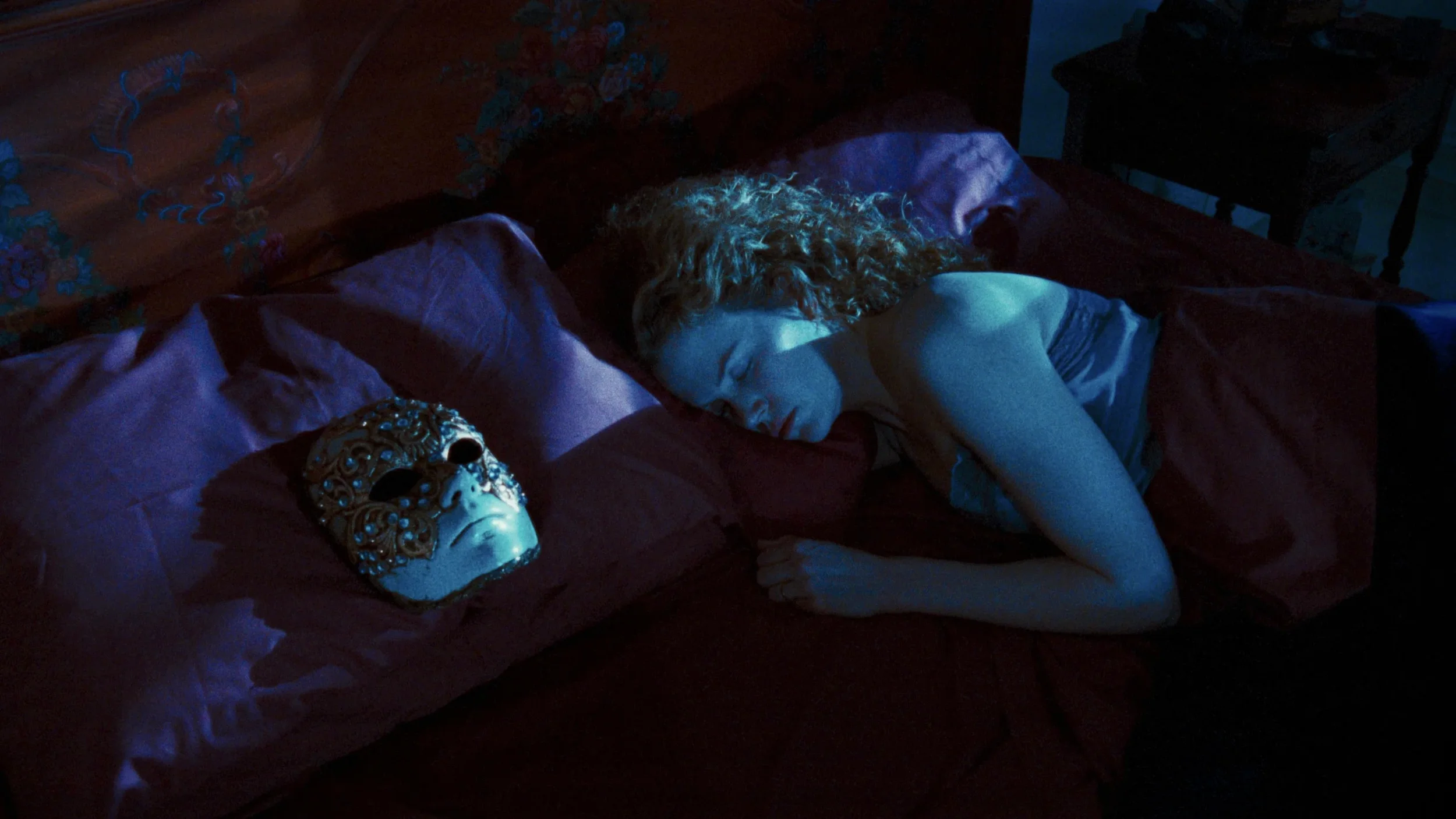
Eventually, Eyes Wide Shut brings Bill back to the room where life as he knew it began to unravel. The bedroom he shares with Alice has grown colder with each return and when he comes home in the middle of the night to discover a mask, the one he wore at Somerton, laid upon his pillow, the room is suffused almost entirely in blue twilight. The people of Somerton not only know where he lives but they have access to the most intimate space he shares with his wife. The security of the home, established so carefully at the film’s outset, has been breached.
Bill breaks down crying and wakes Alice, who embraces him. He promises a confession of his own, telling her that he will explain everything, but the film withholds the substance of what he has to say. We have followed him through the night, witnessed what he has seen and begun to understand the implication of his actions, but the final act of disclosure belongs only to the two of them. We are no longer welcome.
The final sequence takes place in a brightly lit toy store, Helena walking ahead of her parents as they shop. It’s nearly Christmas. There is a collective sigh of relief to be breathed as the film returns the Harfords to the ordinariness of family life and Bill is no longer adrift, separated from the safety of his marriage, but that relief is not ours to share. Reconciliation, or the promise of it, appears to have taken place somewhere Kubrick declined to follow. The Harfords may be able to return to one another, and perhaps they won’t, but there is something very important they need to do as soon as possible.