
Despite a preoccupation with people desperate to be seen, Rotting in the Sun is most compelling when it recognises someone otherwise barely noticed. Sebastián Silva exposes the distance between artistic vanity and unacknowledged care, but his satire becomes increasingly consumed by that which it seeks to ridicule.
2023 • Sebastián Silva • 109 min • MUBI • Thriller / Comedy
Sebastián sits by a fountain in Mexico City's Roma neighbourhood, contemplating ways in which he can end his life without subjecting himself to any sort of suffering. His dog, Chima, oblivious to Sebastián's plight, scurries around just outside the frame. Sebastián is tortured, a filmmaker recently turned to painting, desperate to recover some semblance of artistic purpose and find meaning in life again. Despite having found success in the past, his days now consist primarily of dog-walking and drug-taking because he likes to feel dead.
Mateo, best friend and chief torturer cum landlord, refuses to allow him this luxury, however; it is Mateo's intention to reorient Sebastián toward the world, or encourage him to finally kill himself. Whichever comes first. Sebastián's work is, by his own admission, worthless. For someone that has worked successfully in Hollywood yet abandoned that enthusiasm in order to pursue painted mediocrity, and to draw phallic images on the walls of his studio, the decision is emblematic of his despair. When a photographer arrives to document the paintings, Sebastián's contempt for his work is on full display; they are erroneously ruined, and therefore unable to be shot, but a part of him appears to be at least somewhat preoccupied with the possibility of their recognition.
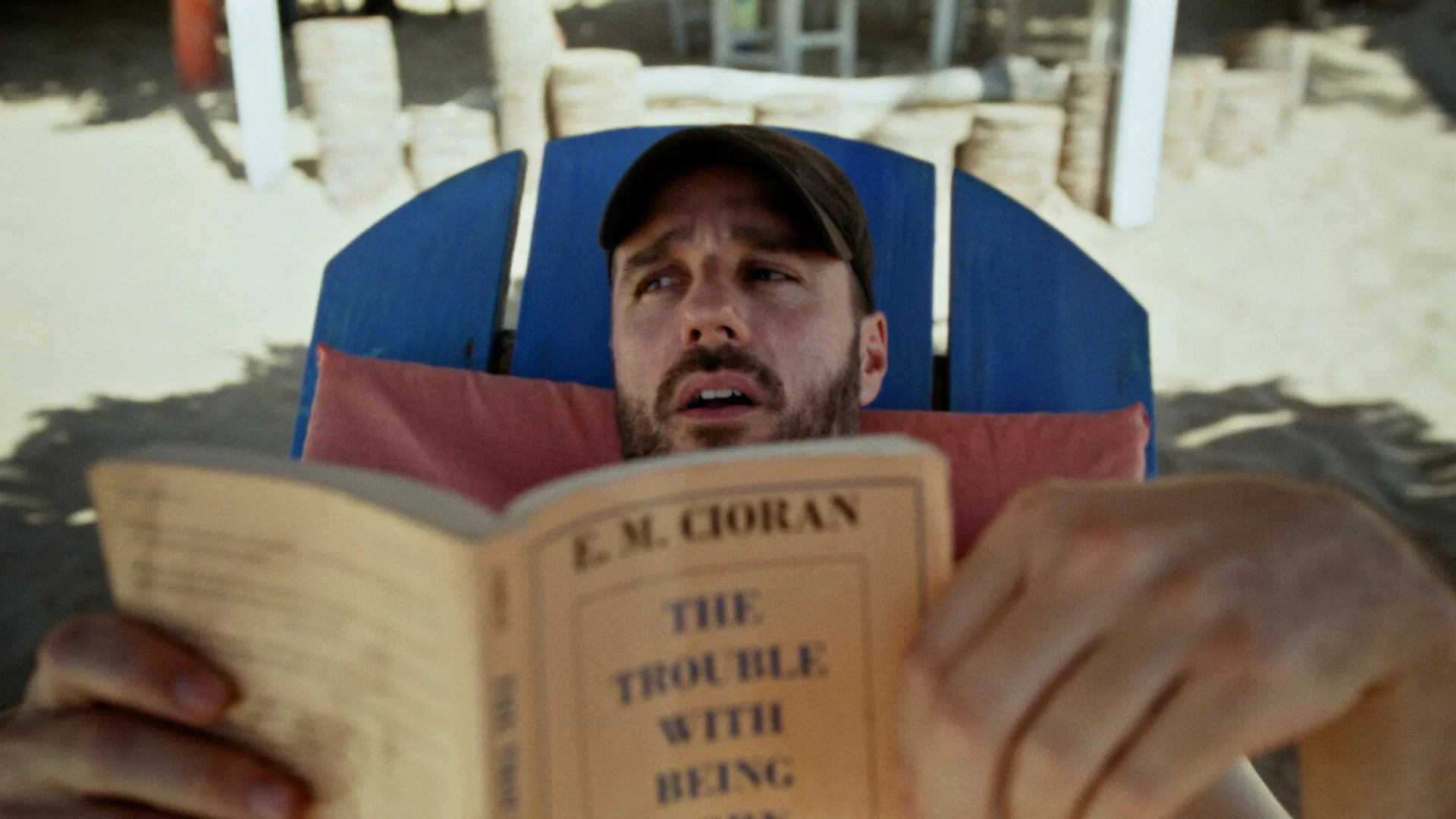
In search of meaning, inspiration or both, Sebastián visits a nudist beach where gay men surrender freely to desire. But even in a place designed to liberate him from society, surrounded by naked bodies and the promise of uncomplicated sexual gratification, Sebastián cannot permit himself to relax. Instead of engaging with those around him, he reads Emil Cioran's The Trouble with Being Born. Where Sebastián remains inhibited, Silva's camera is positively horny and becomes an extension of its protagonist's subconscious, lingering over male genitalia with an abundant refusal to recoil or avert its gaze.
When Sebastián attempts to rescue a drowning stranger, he is caught in a riptide and nearly swallowed by the ocean himself. The stranger is revealed to be none other than social-media celebrity Jordan Firstman, who, having watched one of Sebastián's films the night before, resolves that fate itself must be the reason the world has brought them together. Sebastián is less convinced, increasingly irritated by Jordan's insistence on pitching him a television show, its conception fuelled by vapid self-obsession. This contempt, compounded when Jordan posts footage of him snorting ketamine to Instagram without his consent, becomes, almost remarkably, something Sebastián appears willing to negotiate. When HBO dismisses his own ideas but expresses interest in the proposed collaboration with Jordan, the possibility of a relationship between the two begins to acquire substance; Sebastián considers Jordan artistically inconsequential, but his popularity reveals a route towards the very recognition Sebastián so craves. Their motivations, ostensibly so different, suddenly stop diverging and begin to move toward one another.
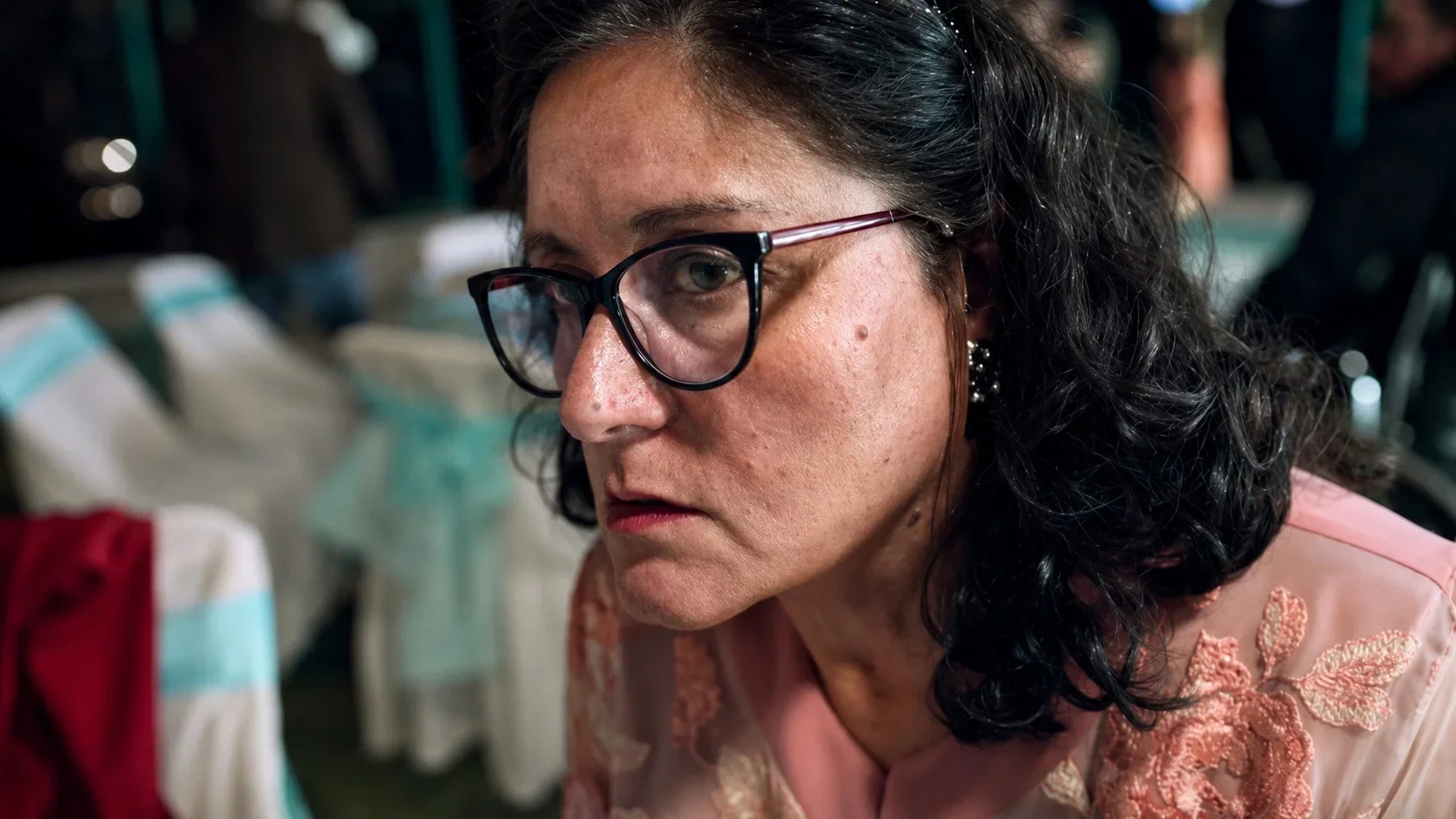
Accompanied by Verónica and playing phone ping-pong with Jordan, Sebastián heads up to the roof in order to retrieve a sofa and, in an instant, he is gone. The brevity with which Silva treats Sebastián's death is extraordinary. For all his preoccupation with ending his life, he is ultimately afforded no agency in its conclusion. Rotting in the Sun has, up until now, been primarily concerned with the anguish of a self-loathing artist. Its decision to violently displace him from its centre is achieved with a remarkable and shocking immediacy that turns the narrative focus to a woman whose existence has remained largely peripheral to his. In the aftermath of his fall, the camera centres Verónica.
Rotting in the Sun (2023) • MUBI
As her expression falters, recoiling from the event and slowly acquiescing to the circumstances in which she has become entangled, she rushes down the staircase amid the sound of Chima howling. The sequence is shot with a terrible and rapidly intensifying claustrophobia, culminating in the confirmation that Sebastián is not coming back. He lies, bloodied and broken, among the shattered porcelain of the toilet upon which he fell. Verónica's transition from shock to self-preservation is inhabited convincingly by Catalina Saavedra, whose implied psychological calculations are particularly unsettling. She is reckoning with this new reality and the consequences that she may face, all of which is compounded by the black humour of Silva; she has no time to waste, she is expected at her niece's quinceañera! But the truth is far less funny than the absurdity on display: Verónica cannot afford to lose her livelihood, nor be implicated in the death of Sebastián, lest the weight of the world she carries upon her shoulders bury her altogether.
Silva's shifting focus and dramatic genre change, from queer-dramedy to blistering crime-thriller, displays a humanity that has otherwise remained largely unseen. Verónica, who has existed merely as a supporting entity in the lives of the men she spends so much of her days around, is a character whose relationship with the world is fundamentally determined by how she cares. Innately, about her job, Sebastián, Chima, about her uncle whose medical treatment she is helping to finance, her niece whose quinceañera is just around the corner and, ultimately, the role she has been destined to play in these people's lives. Despite this, she is barely afforded the privilege of even being noticed. Where Sebastián's misery is afforded considerable space, Verónica's predicament is defined by responsibilities she cannot afford to neglect. Her proximity to wealth offers none of its protections, even though it is her labour that helps to facilitate it. And, yet, Silva refuses to make her predicament morally simplistic. Verónica begins to routinely lie, conceals Sebastián's body and attempts to direct suspicion towards Mateo. These decisions are born of desperation, yes, but they are not absolved by it and her capacity for care remains intact. Even as her desire for self-preservation begins to require increasingly indefensible behaviour.
As Verónica's predicament worsens, Jordan transforms Sebastián's disappearance into public spectacle. His supposed grief, itself another performance, is carefully cultivated for an audience that has scarcely any connection to the man whose death it is being asked to mourn. Silva intersperses these two divergent stories going so far as to cut, in one instance, from Verónica on a dark rooftop to Jordan fellating a man while another two have sex beside them. This repeated contrast exposes the extraordinary disparity between their circumstances: Jordan moves through a world punctuated by sexual gratification and inexhaustible leisure, while Verónica is forced to confront the material consequences of a death neither she nor Sebastián had intended. Initially, these juxtapositions are effective. Jordan can afford to perform grief while Verónica cannot afford the consequences of being implicated in it. But the accumulation of these sequences gradually diminish the force of Silva's satire.
Jordan is able to find time to rearrange his Instagram feed during a facial with friend Martine, who later uses somebody else's baby as part of her performance art. Her work complicates the film's earlier examination of artistic purpose: Sebastián seeks recognition despite his contempt for his own paintings, Jordan turns his existence into material for public consumption, and Martine makes another person's child the instrument of her creative expression. Their motivations are not identical, but the question of what, or whom, an artist is prepared to use becomes inherently difficult to ignore. With Silva and Firstman playing fictionalised versions of themselves, the film is hardly exempt from the vanity it so readily exposes. Self-preservation, and the concept of recognition, are entwined with the film's interpolation of these scenes and Silva's examination of privilege is at its most compelling when these distinctions emerge through the characters' actions. Everybody is attempting to escape the consequences of their actions, or those they could be accused of having committed, by repackaging them in one way or another. But their efforts are not morally equivalent: Jordan protects his image, Mateo his wealth and reputation, and Verónica must navigate circumstance in order to try to retain some control over both her livelihood and freedom.
Jordan remains essentially unchanged. He has inserted himself into something he cannot understand because he seldom takes a moment to consider anything other than himself. That stagnation may be entirely intentional, but its repeated demonstration on-screen grows laborious. It is as though his character is a vacuum, designed to suck the film of momentum at the very moment Verónica's predicament becomes its most compelling. Silva understands the inequalities of the world he depicts, and the sudden displacement of Sebastián from its centre is an effective means of exposing them. Yet Verónica's final confession, lost in translation, offers an incisive irony that cannot entirely compensate for the slightness of the film's conclusion. It is a picture of considerable ambition, whose tonal transformation reveals something more profound than the self-obsession of the artists and influencers it initially appears content to ridicule. But for all its audacity, Silva's continued fascination with the spectacle of people desperate to be seen diminishes the humanity he so unexpectedly uncovers.