
The Love Hypothesis
Claire Scanlon’s The Love Hypothesis races through the relationships that ought to give its romance meaning, mistaking familiar genre conventions for substance while leaving its more compelling questions of consent, autonomy and power frustratingly underexplored.
2026 • Claire Scanlon • 112 min • Amazon MGM • Romance / Comedy
The team behind The Love Hypothesis appear to have mistaken the conventions of romantic comedy for the qualities that make these films work. Being shackled to genre conventions is not necessarily what makes these films successful. Instead, most are carried by their interrogation of what makes us love in the first place. Whether it is moments of mirth and the things that make us laugh, moments of conflict and the things that make us cry, or the moments where we find elation amid a confusing maelstrom of emotion, The Love Hypothesis barely affords us any moments at all.
Claire Scanlon charges through the film's opening fifteen minutes with a barrelling momentum that would be more suited to a short. This approach leaves the audience with very little understanding of what makes the people we meet so integral to her protagonist's world. Anh, for example, a character whose relationship with Olive is the catalyst for the entire plot, is introduced with the same speed and ferocity of a hurricane. She bounds into frame, picks Olive from obscurity and drags her to the front of the class. What follows from this first meeting, we are told, is a friendship unlike any either of them has known. In a visual medium and in the company of romantic comedies that are so uniquely and visually rich, it is egregious that we are simply told this and shown little more than glimpses of actions that make Anh so special to Olive. Although we have a brief window into Anh's generosity, including her willingness to surrender frequent-flier miles that enable Olive to join her and her family for Christmas, we are rarely permitted the opportunity to connect with the two of them. It is odd, then, that for a film whose central conceit is built around this relationship, it is so disinterested in its development.
Olive's decision to fake-date Adam Carlsen, unaffectionately referred to as Dr Evil by his students, is driven primarily out of consideration for her friend's feelings; Anh refuses to pursue a relationship with Jeremy because she believes it would hurt Olive. What follows could have easily explored what we are willing to do for the people that we love, but Scanlon's film appears more preoccupied with establishing the circumstances of its romantic premise than developing the relationships seeking to make them possible.
That impatience, therefore, extends to Olive herself. Before beginning her studies at Stanford, she encounters an unseen stranger in a laboratory bathroom whilst attempting to salvage her eyesight from expired contact lenses, ahead of what she describes as the biggest interview of her life. The film is more interested in this exchange than the interview itself, which is dispensed with via a time-jump to the future that is accompanied by voiceover that informs the audience of its success. For something that appears so foundational to Olive's academic and professional aspirations, the absence of the interview as a scene is peculiar. Its inclusion would have provided an opportunity to explore Olive's anxieties, her relationship with her research and the loss of her mother, whose death from pancreatic cancer informed the very direction of that research. It is another example of a consequential experience that has been reduced to exposition and, although Olive's ambitions are repeatedly invoked throughout The Love Hypothesis, the film seldom seems interested in allowing its viewer to experience them.
The bathroom stranger is, of course, Adam Carlsen himself. The two subsequently encounter one another almost two years later in a hallway after Olive tells Anh that she is on a date. The reunion is framed as more of an intrusion than a meet-cute; Olive impulsively throws herself at him, kissing him without waiting for his consent. What follows in the aftermath is an awkward conversation in which he reprimands her and threatens to file a complaint under Title IX, the federal law prohibiting sex discrimination, including sexual harassment, in federally funded education programmes. The threat eventually comes to nothing, as the two of them discover that a fabricated relationship could potentially serve both their interests: Olive to convince Anh to pursue Jeremy, Adam to secure the renewal of his research funding by demonstrating a tangible commitment to remaining at Stanford.
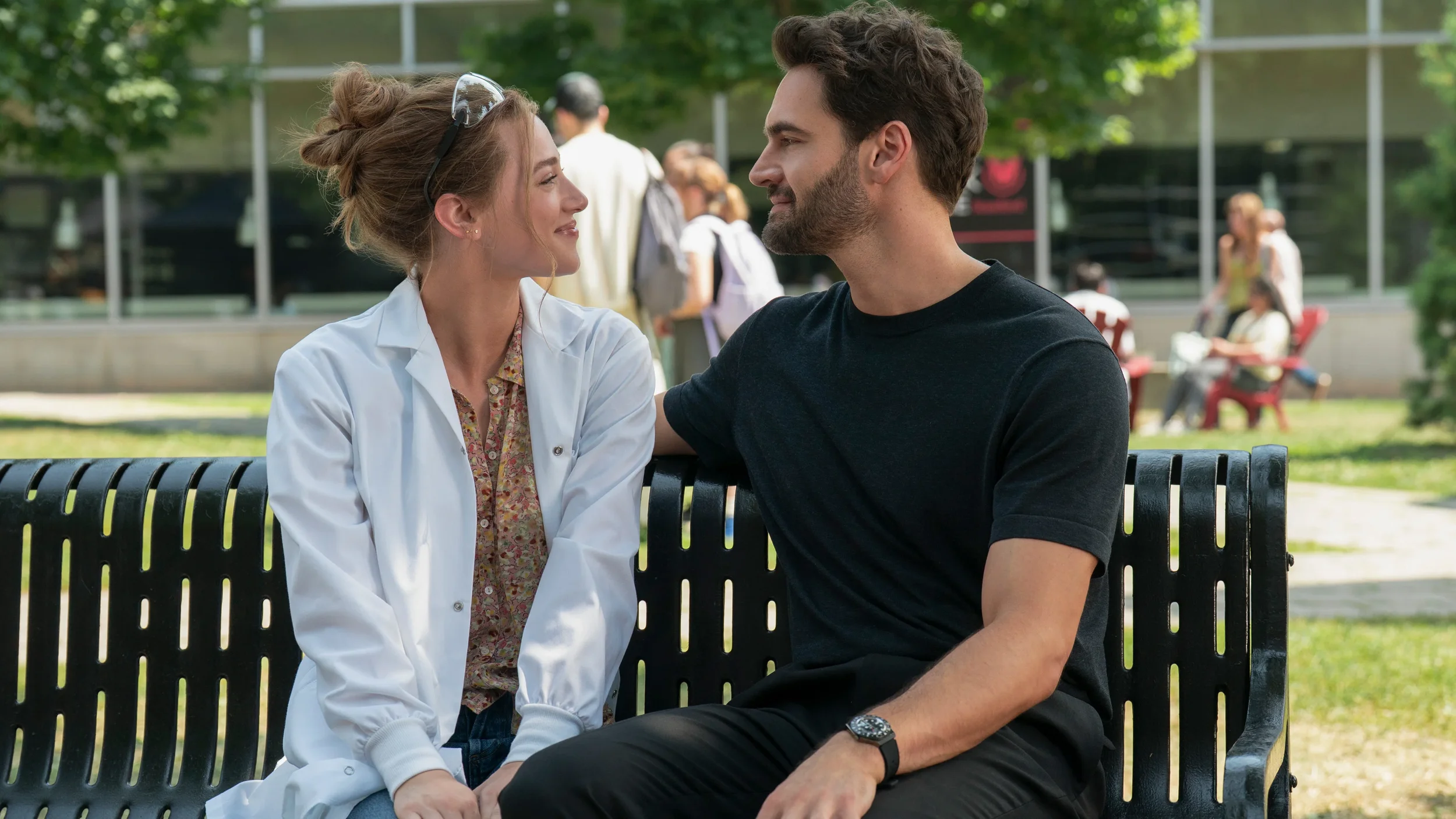
The film does exhibit some charm, however. There are moments in which Adam and Olive are forced to interact while in the company of others, demonstrating a delightful awkwardness between two people who haven't really considered the consequences of their arrangement or agreed upon how they should behave in public. These moments, however, feel few and far between. The jokes rarely land, and whatever chemistry exists between Bateman and Reinhart is insufficient to sustain the increasingly contrived circumstances in which they find themselves.
For example, Adam insists that Olive accompany him to a professional cocktail party which ultimately manifests in some bizarre humiliation ritual courtesy of Adam's old friend and a person who wields the power to secure Olive's future career opportunities, Tom Benton. He implores Olive to pitch her research to a room of academics and supervisors, placing Olive firmly in the position she wanted to avoid. Adam's realisation of this and subsequent decision to accompany her home marks a turning point in their relationship as the affection that they have been pretending to simulate begins to acquire some authenticity.

The Love Hypothesis (2026) • Amazon MGM
Later, following shared success at an academic conference, the two of them finally give one another the space to acknowledge their feelings. Olive attempts to initiate sex with Adam, who initially refuses on the grounds that they have both been drinking. Before they proceed, he seeks reassurance that she is certain of her decision, ensuring that he has obtained the consent she did not afford him at their first kiss.
The film repeatedly returns to the subject of consent, considering it from several different vantage points, though its examination rarely extends beyond the immediate demands of the plot. The contrast between Olive's unsolicited kiss and Adam's refusal to act without obtaining her consent is deliberate, and revisited in the film's final encounter. However, the film also introduces more complicated questions surrounding autonomy, professional vulnerability and the exercise of power, without affording them comparable attention.
The morning after their first night together, Adam encounters Tom, who reveals that he intends to offer Olive a position at Harvard. Knowing that this would mean Olive is forced to relocate and disheartened by the prospect of her departure, Adam removes himself from her life with damning immediacy, ostensibly to protect her professional ambitions. Given what the film has already established about Adam's relationship with Tom, his recognition of the man's cruelty and a shared past in which Tom was oft the embodiment of other people's discomfort, this conflict feels manufactured to enable the film to tread familiar genre beats. Reconciling Adam's development with these actions is difficult, to say the least; he has witnessed Tom's capacity for cruelty first-hand and has inadvertently subjected Olive to that same cruelty. It was that exact event that pushed the two of them together, yet Adam allows one fleeting conversation with Tom to dictate the circumstances of his relationship to Olive without ever consulting her. It is as though the screenplay is so beholden to the conventions of romantic comedy that its characters must behave according to the requirements of the genre rather than their own established motivations.
In the wake of Adam's departure, Tom visits Olive in her hotel room and reveals that her professional future is contingent upon entering a sexual relationship with him, threatening to appropriate her research and destroy her reputation should she refuse. It is an altogether more serious violation of autonomy, exposing the vulnerability of young academics within institutions where professional opportunity can be exploited as a means of sexual coercion. But the implications of this encounter are afforded remarkably little space. Olive's eventual decision to seek support from her supervisor and secure alternative funding follows a cursory intervention from Anh, and her professional recovery is handled with much the same expediency as the film's other developments.
The Love Hypothesis contains the constituent parts of an engaging romantic comedy, and occasionally discovers something charming in the awkwardness of its central pairing. But its more interesting ideas are either insufficiently developed or abandoned in service of the familiar trajectory Scanlon seems so determined to follow. The film reaches its expected destination, complete with a route familiar to all, but the emotional experiences that should make the film's journey worthwhile are all too frequently passed over and, ultimately, its commitment to the conventions of romance comes at the expense of any romance itself.