
The Act of Living
By stripping humanity of a future, Alfonso Cuarón’s Children of Men turns extinction into a question of existence: what gives life value when there is nothing left to inherit it?
2006 • Alfonso Cuarón • 109min • Universal • Science-Fiction / Thriller
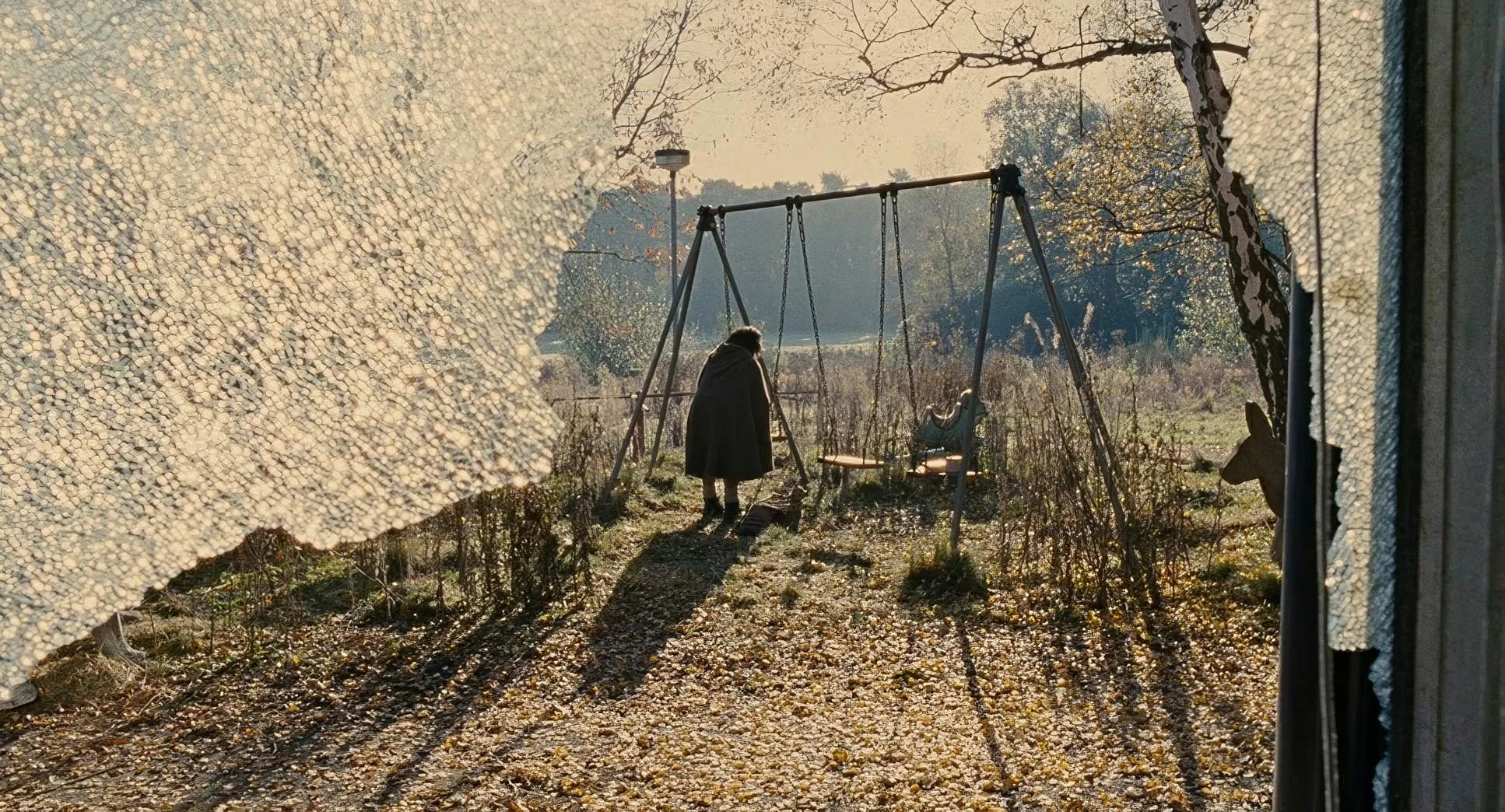
On a swing in an abandoned playground, in a moment of quiet refuge among the weeds, there is a child. A child framed by shattered glass, comforted by a fleeting stillness that the world no longer has the capacity to afford her. Expectation occupies another empty swing. For eighteen years, the world of Children of Men has produced no children. Yet Alfonso Cuarón does not frame this moment through prophecy, panic, or the enormity of Kee’s pregnancy. It is one of the fleeting moments in which the film rests, allowing Kee to play.
Children of Men imagines a world in which humanity’s extinction is something to be immediately reckoned with, rather than an abstraction that this generation need not acknowledge. It has been compressed into the span of a human lifetime. But the film is not principally concerned with whether humanity can be saved. Instead, Cuarón strips civilisation of one of the assumptions upon which it has always organised itself: that there will be somebody afterwards. That children will inherit wealth and homes. That institutions will outlive their founders. That art will find new audiences and take on new meaning. That political struggle will shape societies its participants may never see. That, ultimately, history will continue.
The promise of a future, promised no more.
The apocalypse of Children of Men is not an immediate one. Global infertility does not destroy life on earth, nor does it inaugurate humanity’s crises so much as impose an endpoint upon those already underway. Instead, it announces a terrible inversion of birth: the beginning of mankind’s slow march toward oblivion. There appears to be nothing anyone can do to stop it, and yet life continues. People continue to wake up in the morning even as their institutions become obsolete. Schools fall into disrepair. Governments assert themselves, dedicated to the systems of control that have previously ensured their continuity. Art is afforded refuge from the chaos, insulated from destruction.
Amid the crumbling brick of a civilisation approaching a finality it is all too aware of, humanity continues to assign value to experience, relationships, possessions and beliefs. Most human beings already live with the knowledge that they will die. That knowledge gives existence a boundary, but civilisation’s apparent longevity offers a relationship between today and a future beyond it. In Children of Men that consolation no longer exists. Theo Faron may die, but so, eventually, will everybody capable of remembering that he lived. Guernica may survive its author by centuries, but Nigel’s Ark of the Arts cannot preserve an audience for it indefinitely. Governments may use their final days to consolidate power; revolutionary movements may dismantle it. Neither can escape the same terminus. Still, they continue.
This is where the apparent nihilism of Children of Men becomes complicated. Its entanglement with extinction does not make existence retroactively worthless. For those at the centre of this picture, the end will certainly come. Cuarón’s refusal to render their experiences meaningless because they must end brings the film close to one of its overriding truths: impermanence is not the opposite of significance.
Children of Men makes this argument without reducing it to reassurance. Its humanity is capable of wondrous tenderness and astonishing cruelty, often within the same spaces. Institutions construct moral justifications for brutality, and political movements reproduce the coercion they claim to oppose. People choose to protect one another, exploit one another, mourn and kill. The film does not propose that existence is meaningful because humanity is fundamentally good; it does not require humanity to be good at all. Instead, Cuarón confronts something more difficult: that to be alive is to exist among other consciousnesses, and that what is done with existence matters precisely because life is finite.
Children of Men (2006) • Universal
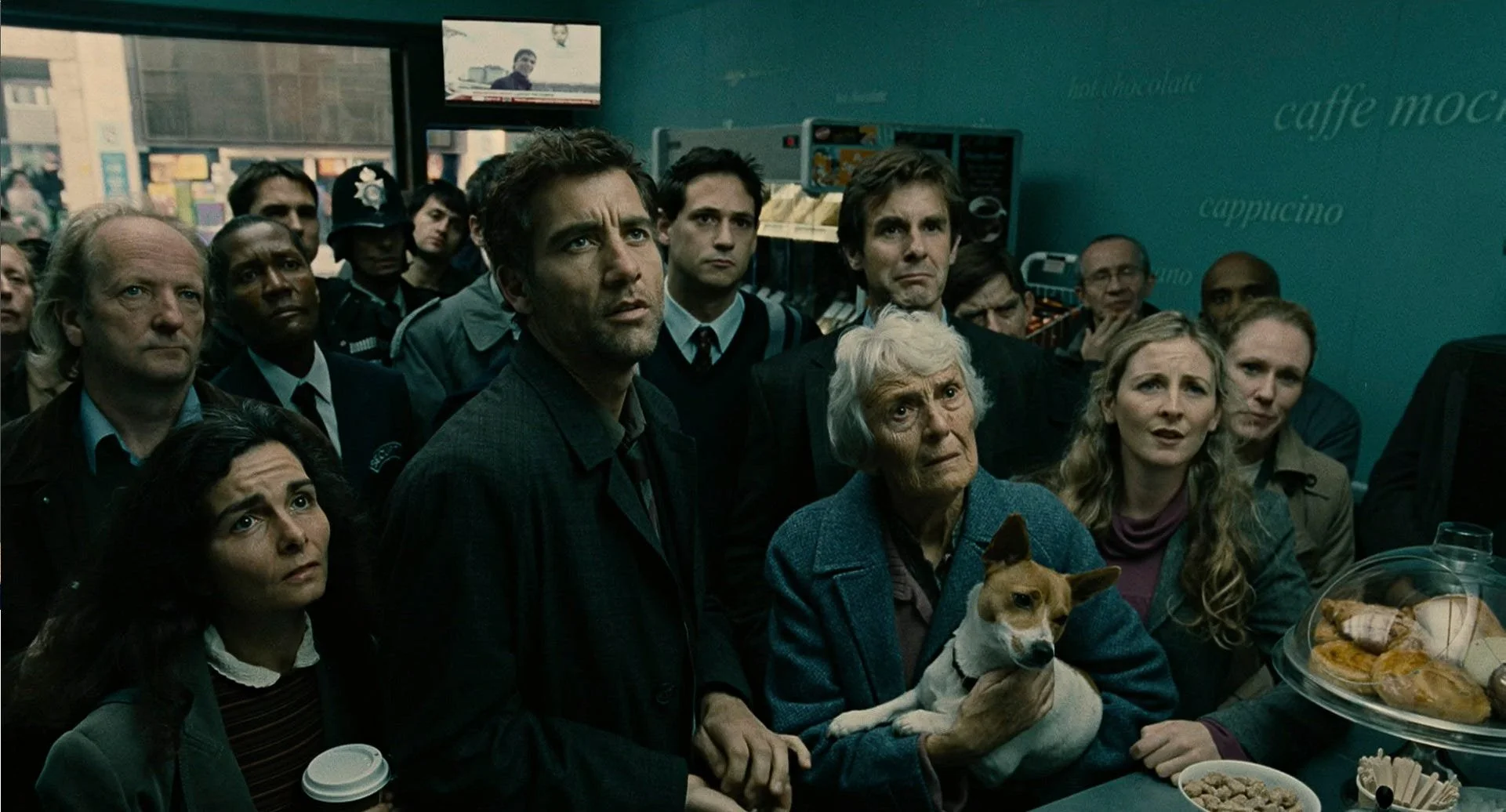
Theo Faron is a symptom of the world he inhabits. He has retreated from participation in its fear, in the collective suffering he understands as performance and, fundamentally, in his own life. A forlorn bureaucrat, disillusioned and apparently unmoved by the national mood that blackens in the wake of Baby Diego’s death, Theo leads a perfunctory existence. Around him, strangers stare at television screens in disbelief; for them, the death of the world’s youngest person is another reminder that humanity is ageing toward extinction. Theo barely registers it. He is a man that has taken refuge in routine. The rituals of mediocrity, the safety of the mundane: coffee, work, alcohol and their repetition offer him a structure that he can understand and replicate, something the wider world can no longer guarantee. It is something that he has allowed to mutate into defence, cultivated carefully enough to prevent grief from consuming him entirely. He fortifies his morning coffee with whiskey and moves through London with the weariness of someone who has learned not to expect anything from it.
The apocalypse of Children of Men takes multiple forms. For some it is infertility; for others, displacement, detention, or the disappearance of the structures that once made ordinary life possible. Theo has already experienced the collapse of a world he loved. It is beneath the debris of procedure in which he has buried himself, that he survives. He is a man who has abandoned hope, abandoned the pursuit of anything that might make life worth waking up for.
The crisis of infertility forces humanity to confront the disappearance of its future. Theo understands that loss through the death of his son, Dylan. Grief permeates his choices and surfaces in flashes of spite, as though he is angry not at the world for taking children, but for taking his. Like so many other parents, he lost his child and, with him, the certainty that anything invested with meaning could be safely carried into tomorrow. Humanity’s expiration date is seared into the public consciousness, but the future had already expired for Theo the day he lost his little boy.
Julian Taylor enters through subterfuge and represents something Theo has spent years attempting to forget: the world he once knew. She belongs to the period before routine became refuge and political conviction gave way to resignation. Unlike Theo, Julian refused to withdraw. She believes in the cause of the Fishes and in the possibility of political action, an ambition they once shared. However compromised that cause may become, she believes in the necessity of attempting to change the conditions beneath which people are forced to live.
These differences are made more complicated by the fact that they carry the same grief.
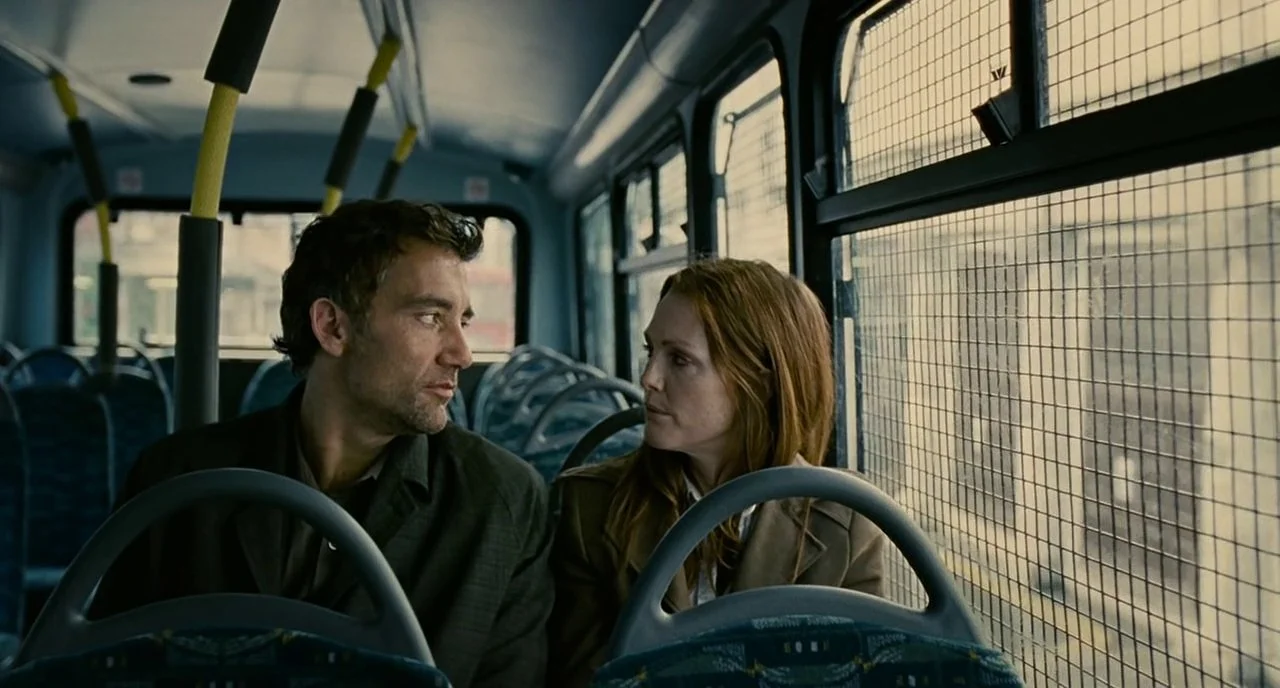
Dylan was not only Theo’s child. Julian lost him too. But Theo has come to treat their different responses to that loss as though they reveal the depth with which each of them experienced his death. When he sits with her on the bus, he voices his resentment: he never understood how she could have gotten over Dylan so quickly. In a world from which motherhood has almost disappeared, this feels particularly cruel. Julian’s response is immediate. She did not get over him. She thinks about him every single day.
It is clear that Theo has mistaken movement for recovery. Because his own grief demanded withdrawal, Theo has mistaken that same withdrawal to be the natural condition of mourning. Julian disrupts that assumption, exposes that mistake. Her continued political engagement does not mean that Dylan mattered less to her; her pain does not function as a prerequisite for the abandonment of everything else alongside it.
Children of Men (2006) • Universal
Her activism predates the birth of her son. She did not manufacture a cause from his death, but used it as a springboard from which to sustain the beliefs that she and Theo once shared. While he permitted loss to become the organising principle of his life, Julian allowed it to coexist with a life that continued beyond it. Her reappearance after almost twenty years clearly threatens the architecture that Theo has built around himself, long before he understands what she is asking of him.
When he is taken from the street and bundled into a van, he finds himself before a woman he had assumed lost to his present life and she is asking him to become involved again. Instinctively, he refuses. To help her would require him to step beyond the boundaries of that which he designed precisely to prevent such investment. But she offers him money. An explanation he can tolerate.
The transit papers Julian needs can be obtained through Nigel, Theo’s cousin, whose proximity to government gives him access to the machinery of the state. Payment preserves the appearance that Theo’s involvement is merely transactional. Money permits him to behave as though nothing meaningful has changed. Yet when Julian accuses him of returning for it, he frames his return as a reason to see her.
There is nothing disposable about the way these characters treat each other. Even after nearly two decades apart, in a world ravaged by the existential dread that hangs over civilisation, they approach one another with tenderness. Julian implicates Theo in her plan because she trusts him. Their shared history is not something that was erased by Dylan’s death. It, too, is something they have carried and Cuarón has it re-emerge in fragments: memories of their son, a kiss carrying more emotional weight than either is willing to acknowledge, the teasing familiarity of two people who once knew each other intimately. Julian is asking Theo to participate in something larger than the life he has constructed, but also reminds him that he was once capable of doing so.
The change is not dramatic. The excavation of the man he once was, the version of Theo that Julian knew and fell in love with, occurs slowly across the time they spend together. He does not suddenly rediscover political convictions lost to time. Later, in fact, he tells the Fishes that their politics are irrelevant beside Kee’s need for a doctor. Slowly, however, he begins to re-enter Julian’s world. He laughs. He teases. He allows himself to be irritated by Julian in ways that belong to familiarity rather than estrangement. There is a rhythm between them that existed before the losses that have come to define who they are today and, for a few minutes, grief no longer occupies the entirety of either character’s experience.
Julian embodies a lesson that Theo has refused to understand: grief need not end before life can continue. Pleasure does not diminish the sincerity of loss and participation in the act of living is not betrayal to those you’ve lost. Political conviction, humour, irritation, desire: the things he buried beneath routine remain accessible because they never truly disappeared. Julian makes that impossible for him to ignore.
Then, on the winding roads outside Canterbury, the film takes her away too.
Children of Men (2006) • Universal
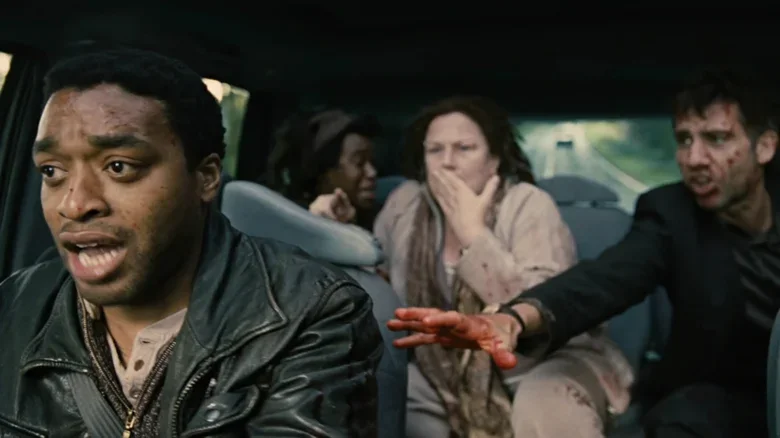
Cuarón’s camera takes on a vérité quality throughout the film. His direction, combined with Emmanuel Lubezki’s photography, places the audience alongside its characters. The camera navigates tenderness and brutality with an alertness that leaves little room for detachment. During the ambush, the frame offers no refuge outside the event.
When the mob emerges from the woodland, he is abruptly robbed of the opportunity to know Julian once more. The ensuing chaos barely allows anyone time to breathe. The camera remains within the car, trapped among its occupants. Blood soaks through Julian’s clothing. Theo lurches across from his seat. Luke grips the steering wheel, his visible tension acquiring a different meaning once his role in the ambush becomes clear. Miriam leans across Kee in desperation, while Kee protects the secret she carries. The same horror manifests differently across every face, each consciousness forced to encounter the event from an irreducibly private position.
There is barely time to register what has happened before police pursue the car and force it to stop. Julian is beyond saving, and Theo’s implication in Kee’s journey has become more dangerous than he could have imagined. Before reassurance can settle, Luke is on the road, gun in hand, and the officers lie dead. The camera lingers near their bodies without quite centring them, as though bearing witness and recoiling simultaneously. Escape from the claustrophobia of the blood-stained vehicle offers only another encounter with the violence Luke perpetuates, before the film cuts back to the group in the wood.
Theo breaks off from the rest as Miriam prays over Julian’s body. He sips whiskey from the bottle before beginning to reckon with the fact that he will never see her again. He knows, in this moment, that he will never hear her laugh. Never be irritated by her convictions or her motives. As he settles into this new reality, he nearly collapses beside a tree, cradling himself while he sobs. Dylan is dead, and now Julian is too. Whatever remained of the family Theo once understood is gone.
There is no time to mourn.
Theo is not afforded the retreat that he allowed to follow Dylan’s death. The world moves before he is ready to move with it. There are questions to answer, danger to navigate and, though he does not yet understand it, a life depending upon his continued involvement. Grief has entered his life again, but circumstance will no longer permit him to build a world around it.
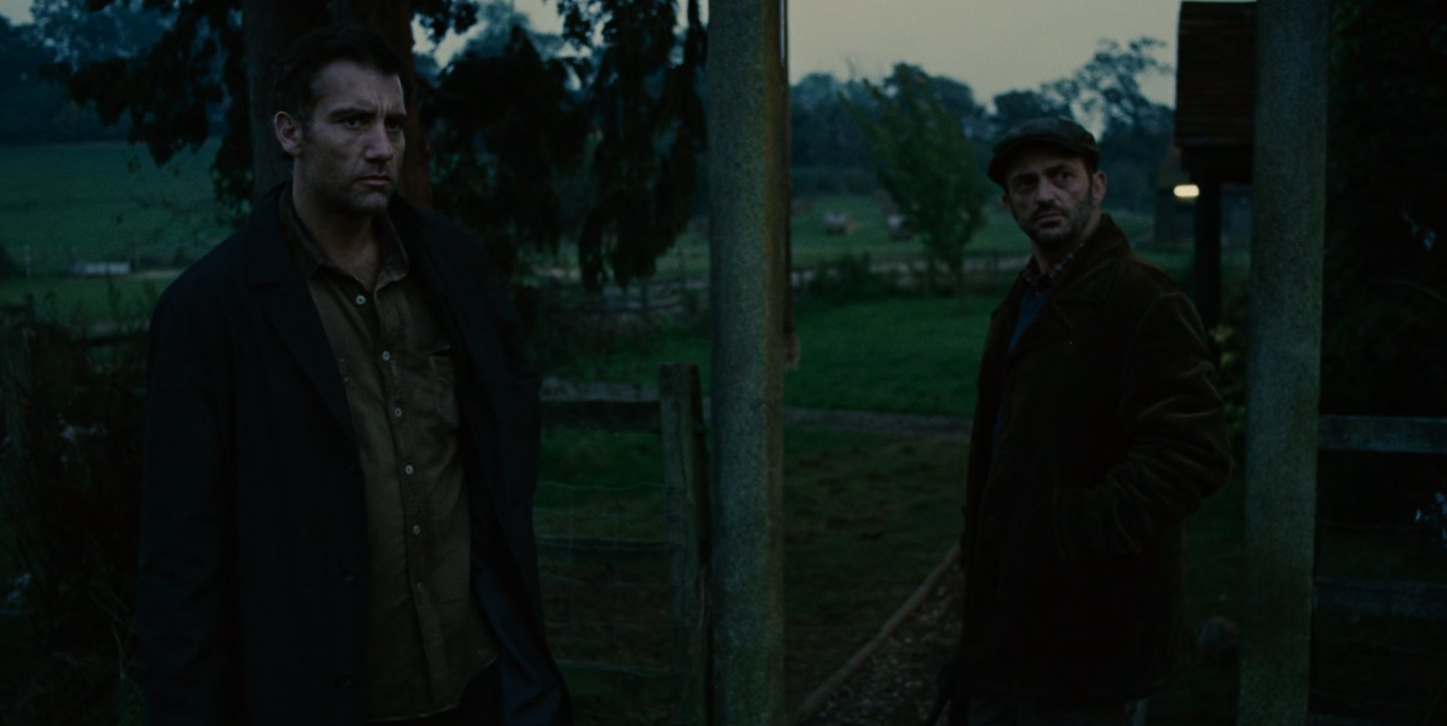
In the wake of one shattered world, Theo arrives at the farmhouse to find another already beginning to form around him. The machinery of the Fishes does not stop with Julian’s death. Luke breaks the news to those gathered and turns almost immediately toward the election of a new leader. There is the acknowledgment of a collective grief, but it is subordinated to organisation. Theo, meanwhile, chain-smokes at the edges of the group, still struggling to understand the violence he has witnessed and the life that has once again been removed from him. Julian trusted him. Luke plainly does not.
Children of Men (2006) • Universal
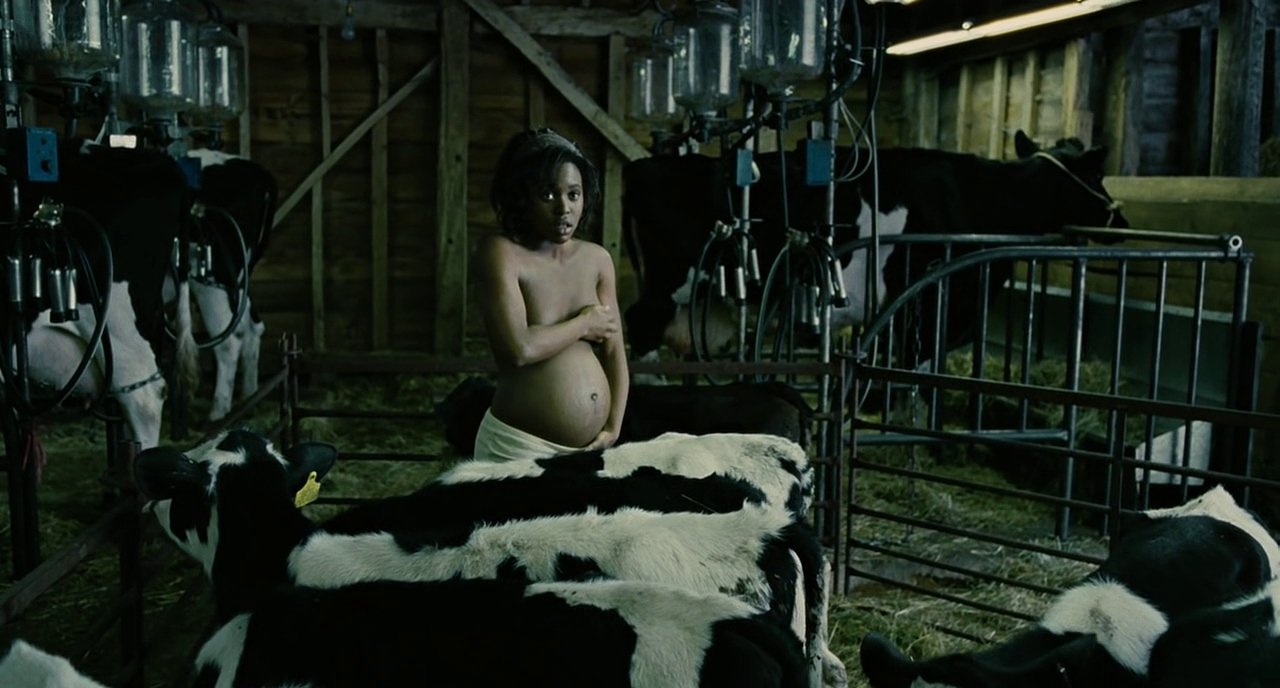
Tomasz is assigned to watch him. The walls around Theo are no longer emotional ones of his own making; they belong to somebody else. Miriam interrupts this arrangement and leads him toward a barn, where cows stand tethered, their bodies still participating in the reproductive cycles human beings have lost. Kee, surrounded by them, wants to talk about the cows and their titties. Even immediately after Julian’s murder, Children of Men permits absurdity to survive. Kee may be frightened, but she is capable of finding humour in her surroundings.
The end of the world has not relieved anybody of the peculiar business of being alive.
Finally, she begins to tell Theo why she brought him there. Julian intended Kee to reach the Human Project aboard a hospital ship disguised as a fishing boat known only as the Tomorrow. If anything happened to her, Kee was instructed to trust Theo and him alone. In the wake of her death, that trust becomes an obligation he cannot easily refuse. Julian has ensured that her involvement in his life will survive her. Kee needs him to understand the scale of what she is asking. When words fail, she begins to undress. Theo recoils, briefly misunderstanding, before the truth becomes impossible to avoid.
She is pregnant.
The staging acquires an unmistakable religious charge. Kee is standing in a barn surrounded by animals, soft light falling upon her belly as the score rises beneath Theo’s disbelief. The visual vocabulary of the Nativity is difficult to ignore: a young mother, an impossible child, a humble space made momentarily sacred by the revelation occurring within it. Yet Children of Men does not allow the image to settle comfortably into Christian allegory. Kee is not transformed into an icon. She remains profane, funny, frightened and unmistakably herself. There is something miraculous here, even if nobody yet agrees on what the miracle means.
Theo has barely begun to comprehend what he is seeing before the revelation becomes communal. Luke and the Fishes enter, converting an intimate disclosure into something approaching public property. Miriam objects: Kee chose to tell Theo; the pregnancy belongs first to the woman carrying it. Luke appears to accept that distinction, but subsequent events expose how little he believes it. To him, the child will become inseparable from the struggle the Fishes intend to wage.
Those in Kee’s orbit have already begun constructing different meanings around her pregnancy. Kee herself understands it largely through experience, though later she admits that nobody ever taught her about babies. The extraordinary condition of her body is something she must learn from within.
Children of Men (2006) • Universal
Miriam sees something closer to revelation. Before the advent of humanity’s infertility, she worked as a midwife, a history that gives Kee’s pregnancy an almost unbearable significance: she belongs to a generation of women who watched pregnancy disappear, witnesses to an expectation that repeatedly gave way to loss. In Kee, she is offered the possibility of assisting not another woman into grief, but a mother into motherhood.
Julian saw responsibility. Whatever political meanings may surround Kee, her plan was ultimately to place the young woman and her child beyond the possession of the state or the Fishes and into the hands of the Human Project, where the pregnancy might be understood and protected.
Luke sees something else. A symbol. A flag. Proof around which political action can be organised. Kee’s child is capable of becoming an argument against the order Britain has constructed, and therefore something whose existence can be converted into power.
Theo, at least initially, sees none of these things. He sees the impossible.
Once again, Children of Men forces Theo to encounter something he neither sought nor believed he would see. This time, the object of his witnessing is not death, but its apparent opposite. The fact of Kee’s pregnancy is indisputable. Its meaning is not. What follows is therefore not simply a struggle over the survival of one woman and her unborn child, but a struggle over the meanings other people assign to them. Miracle, responsibility, political instrument, scientific possibility, future: Kee’s body becomes the site upon which competing understandings of humanity are projected almost as soon as her pregnancy is revealed. Even the miraculous cannot escape mankind’s compulsion to make meaning from it.
The distinction between meaning and possession does not survive the night. While the farmhouse sleeps, Theo is disturbed by the arrival of the bikers who assassinated Julian. They are Fishes themselves. Luke and the others bundle them into a back room, where Theo overhears them discussing a future they have already begun to construct around Kee. The Uprising is coming and to Luke, the first baby born in nearly two decades offers something political activism rarely receives so neatly: iconography around which belief can organise itself. Kee has become a cause before she has been permitted to become a mother.
This contradiction is difficult to ignore.
The Fishes define themselves through resistance to a state that imprisons, dehumanises and exerts control over the bodies of those it considers politically inconvenient. Yet, confronted with Kee’s pregnancy, the movement begins to reproduce the logic of the power it opposes. Her body is valuable because of what it contains; her child is valuable because of what it might be made to represent. Liberation becomes another justification for ownership. Julian’s murder was engineered by people with whom she shared a cause, because her understanding of Kee’s future stood in the way of theirs. The political world Theo abandoned has reduced somebody he loved to an obstacle between others and the future they believe ought to exist. This time, though, he exhibits a refusal to withdraw.
Beneath the urgency of their escape lies a change in Theo’s relationship with grief. While Dylan’s death drove him inward, the discovery that Julian was betrayed forces him outward. There is no structure of routine sufficiently strong enough to contain that which he has learned. He wakes Kee, a choice that is not yet an expression of faith in humanity; he has no assurance that the Human Project is real, still less that Kee’s pregnancy will reverse infertility. Nor does he recover the political idealism that once bound him to Julian. But a young woman is in danger; her child is being transformed into an instrument before it has even been born. Julian trusted him to prevent that.
He takes leave from the farmhouse with Kee and Miriam before the Fishes can enact the future they have imagined for them. And though their escape does not resolve the question of what Kee’s pregnancy means, it does something more fundamental: it preserves, temporarily, Kee’s ability to determine what happens next.
On the run from the Fishes, with the apparatus of the state offering no safety, Theo returns to the one place that has consistently offered escape: Jasper’s.
Children of Men (2006) • Universal
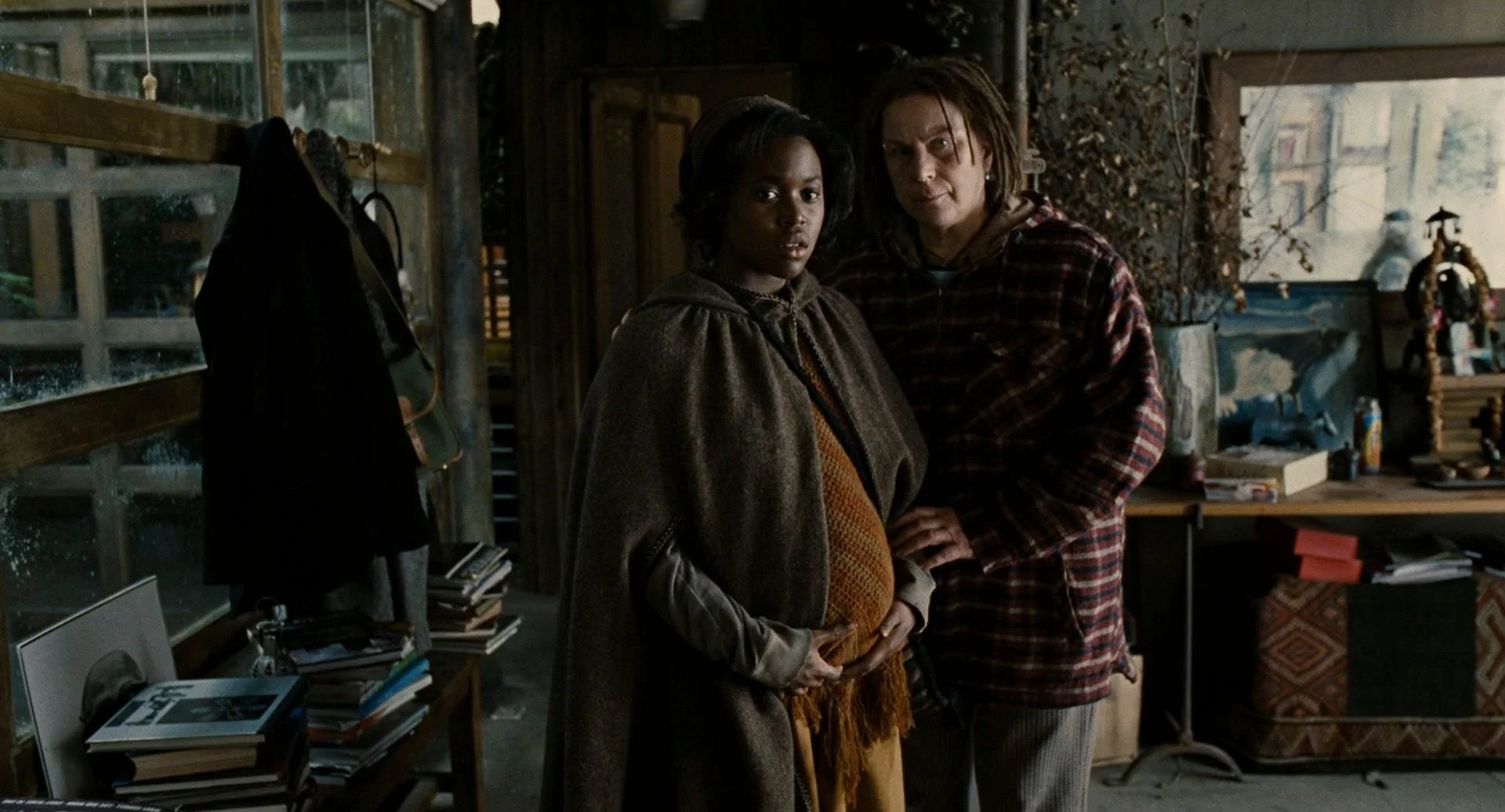
In their arrival, Kee is framed almost iconographically, wrapped in warm colour and caught in the light that so often accompanies her pregnancy. She stands in the doorway with Miriam beside her, hands resting upon the life she carries. Music swells and Jasper needs little explanation: a miracle at home. He does not interrogate Kee or demand a role in the future her pregnancy might promise. Cuarón allows him to behave as he always has, by looking after people.
The film cuts to hospitality. Kee is sprawled out across the sofa, Theo is using a foot bath and Jasper is waxing lyrical as he jovially manoeuvres around the room, offering each of them more food from the pan he is wielding. His home has always functioned as sanctuary for Theo, and now it is sanctuary for Kee as well. That sanctuary, however, has been purchased through experience as opposed to innocence. Janice, his wife, remains the clearest evidence of that. A newspaper clipping glimpsed within the house connects her condition to alleged torture at the hands of the security services, reducing a photojournalist once capable of documenting the world around her to someone now almost entirely dependent upon her husband’s care. So although Jasper’s home sits beyond the state’s immediate reach, its violence has already entered his refuge. In fact, its consequences live there.
The life Jasper has built is eccentric and deliberately removed from the institutions beyond the trees, but it is not empty. Theo may have spent years using withdrawal to reduce the number of things that have had the capability to hurt him, but Jasper’s retreat allowed him to invest more deeply in the few relationships he retained. He cares for Janice. He welcomes Theo without ceremony and allows him to function there with the ease of someone for whom the house has become an extension of home. So, when Theo arrives carrying Kee and Miriam into danger, Jasper does not ask what their presence might cost him before offering assistance. This is why Theo has leaned on Jasper for so many years: emotionally, materially and, perhaps most importantly, because in Jasper there exists evidence that a different relationship with the end of the world still remains possible. Jasper is, therefore, one of the few people left that remains capable of articulating what happened to Theo.
As Theo moves elsewhere in the house, Jasper recounts the story of Dylan and the life Julian and Theo once shared. His framing is deceptively simple: faith and chance. Theo and Julian believed that the world could be changed. Their politics, their relationship and eventually their family represented a kind of faith made tangible. Dylan was belief made flesh. Then chance intervened and killed him. Theo, in his grief, allowed chance to win.
Cuarón stages the conversation with curious discretion. The camera does not settle comfortably inside the room with Jasper, Miriam and Kee. Instead, it remains closer to Theo, listening from the threshold as another person explains his own history, one Theo has spent years refusing to examine. For once, Theo is not merely the film’s witness. Instead, he is its subject. Jasper narrates his life to the others while Theo stands just beyond the conversation, and the audience with him. There is proximity enough to hear and yet distance enough to recognise the exposure that Jasper offers to Kee and to Miriam.
The distinction between Jasper and Miriam is subtle but important. While Miriam believes that everything happens for a reason, Jasper does not appear to require such certainty. He recognises chance as an active force in the world, capable of destroying faith without explanation, but he has not allowed its existence to make participation in life worthless. Nowhere is this attitude clearer than when it becomes apparent that Bexhill is their only route to the Tomorrow. Jasper believes in the Human Project without being able to verify its existence. He cannot know whether Kee’s pregnancy will lead to another or even whether her child will survive its infancy.
None of that prevents him from helping.
He acts because he knows he can offer them a route into Bexhill and reaches for that possibility without asking for ownership of whatever future may result from it. To Jasper, meaning is relational. He finds it in Janice, in Theo, in the people there are to know and to love. When they require something from him, whatever it may be, he acts.
That simple truth does not fracture under pressure.
As the Fishes approach, Jasper refuses to follow the others. Janice cannot easily be carried into the danger awaiting them; her care binds him to the sanctuary he has constructed. To take her would endanger their escape, and to leave her would betray the relationship around which his life is organised. So he remains.
Quietus, the state-sanctioned suicide kit that is advertised with obscene cheerfulness throughout the country, ceases to be merely an object of his derision. Jasper previously mocks the contradiction of a government that is willing to distribute death while criminalising the comparatively harmless means by which he routinely escapes reality. Now he repurposes that same instrument in the face of something considerably more immediate. He knows, instinctively, what will happen when the Fishes arrive and he knows what Janice may be subjected to if they find her alive. His recognition that there is a point beyond which he cannot protect both Janice and the people fleeing through the woods motivates him to act once more. There is no comfortable moral certainty in what follows. Janice cannot meaningfully articulate consent in the moment, and Jasper nevertheless makes a decision on behalf of the person to whom he has dedicated years of his life. Love is present, but it does not simplify the ethics of his choice.
When the Fishes arrive, he meets them with the same humour that has characterised his existence from the beginning of the film. The performance is absurd and he offers hospitality to the people who have come to kill him. Unlike Luke, Jasper recognises that participation does not equal entitlement. He can facilitate Theo, Miriam and Kee’s escape without proclaiming ownership over any one of their lives. Even as violence begins to close around him, he makes jokes. He remains, fundamentally, himself. The state could irreparably harm his wife, Dylan could be lost to chance, and the Fishes can execute him at his own home, but none of them can compel him to encounter death on terms entirely dictated by them. In one final act of defiance, he spits at Luke, aware that his time has come to an end.
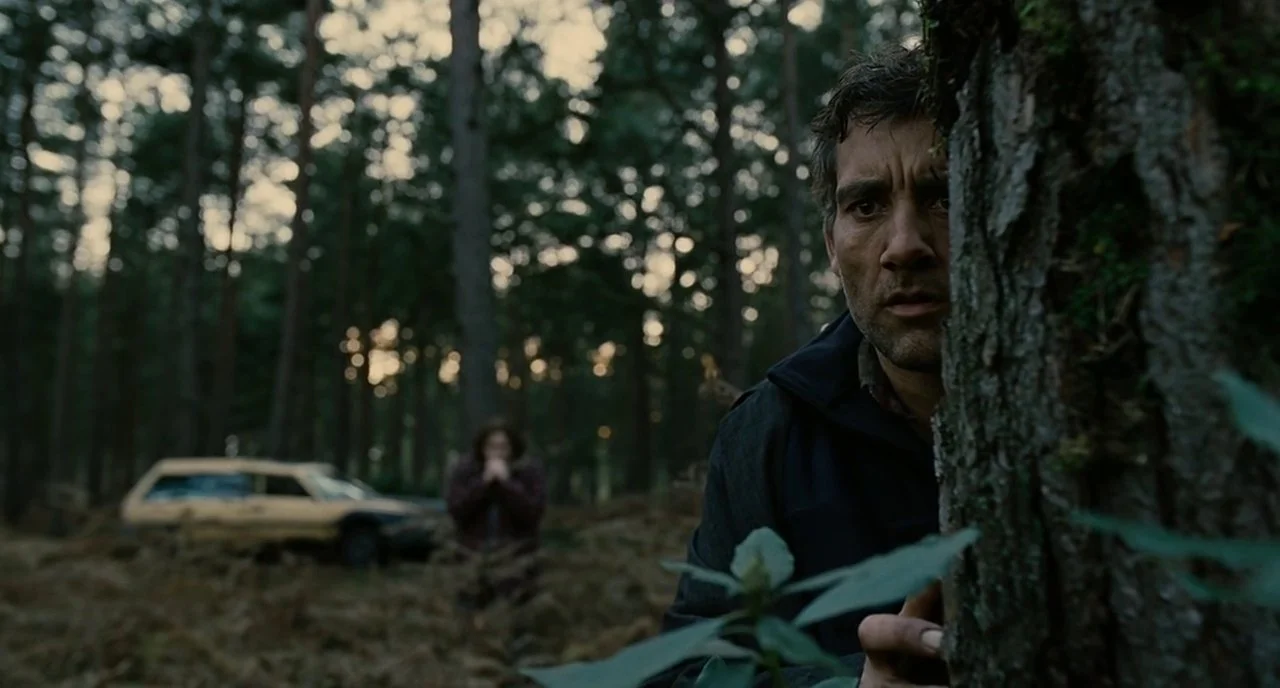
Theo stands watch in the distance, looking on from the edge of the trees. The camera looms over his shoulder, forcing the audience to join him, a place where witnessing affords no power to intervene. To move toward Jasper would jeopardise Kee and compromise Julian’s last intention, so there is nothing to be done but remain hidden.
The pattern is becoming unbearable: Dylan, Julian, Jasper.
Miriam’s faith offers no comfort. Her insistence that everything happens for a reason turns to acid in his mouth. For Theo, looking back toward the house where Jasper has just been murdered, the proposition becomes almost grotesque. What reason could there possibly be for this? What larger design requires the death of another person who had just welcomed them so openly, offering shelter, friendship and care? Regardless, she continues to maintain her belief in design. Ultimately, Jasper dies without learning whether Kee reaches safety, but his assistance does not become worthless simply because he cannot know its outcome. It has already meant something to the people escaping through the woods.
Children of Men (2006) • Universal
In the circling maelstrom born in the wake of Jasper’s murder, the world slows on its axis as Theo, Miriam and Kee reach an abandoned school. After another death, another explanation for suffering that Theo cannot accept, Cuarón finally permits his characters stillness and the camera is afforded room to breathe.
The building the three of them enter has been reclaimed by nature. A vestige of human knowledge, built to perpetuate that which is known, to reach across from one generation to the next, buckles beneath twisting vines and overgrown shrubbery. Plants sprout in playgrounds, ivy climbs the walls and, as the classrooms stand empty, vegetation asserts itself into spaces from which children have gradually disappeared. Animals wander the corridors that once contained lessons, arguments, friendship and, perhaps most importantly, noise. While the remains of the institution continue to stand, the purpose for which it was built has long disappeared.
Outside, removed from the chaos, Kee perches upon a swing. It is the same image through which the significance of Children of Men can first begin to be understood: a young woman carrying within her the only known unborn child in the world, playing in a space for children who no longer exist. Lubezki frames her in shattered glass. Another swing, empty, moves beside her and drifts in the wind. The natural world has already begun assuming ownership of everything humanity is preparing to leave behind, and yet Cuarón does not look to the future. Instead, he looks back.
Through Miriam, infertility first announces itself in the quiet routine of an antenatal clinic. She recalls the change not as an abstraction across television screens, but as something that happened beneath her hands. Three of her patients miscarried in a week; five more the next. Pregnancies began to fail earlier. She remembers looking seven months ahead in an appointment book and finding no names. A colleague elsewhere, then another in Sydney, had no new pregnancies either. The familiar structures through which the future once announced itself had fallen silent. And as the sound of the playgrounds faded, despair set in.
“I was there at the end.”
For much of Cuarón’s film, extinction exists as a potent political reality, social condition or philosophical proposition. Miriam, however, remembers with precision how it became experience. Her words carry with them a weight that Theo once might have rejected. This is a woman who insists that all events possess reason; that suffering exists within some design contemplated by something altogether stranger and more powerful than those who live to experience it. In the wake of Jasper’s death, Theo finds these beliefs intolerable. Chance, to him, has repeatedly demonstrated its supremacy over anything merely resembling belief. Before the school, he had rejected her certainty. Here, without accepting it, he briefly speaks in its register.
“Now you’re gonna be there at the beginning.”
Something changes, somewhere within him. He allows himself to imagine the possibility of the future. There is no evidence that Kee’s pregnancy is anything more than a singular miracle; whether it can be repeated is unknowable to them. But he has already seen grief coexist with participation in Julian, and action survive uncertainty in Jasper. Now, sitting amid the physical remains of a world built for children, he permits himself to speak of a beginning.
Clive Owen delivers the line as though it surprises even Theo. Light seems to return to his eyes, not because humanity is saved, but because something may happen tomorrow that is worth being present for. Miriam welcomes this with a smile. Her faith and Theo’s scepticism have not reconciled, but they do not need to. The building is decaying, the playground abandoned. One pregnancy will not refill these classrooms with the voices they remember disappearing. A glimpse of hope does not repair the world, but the beginning, if there is to be one, looks remarkably like the act of living.
That glimpse meets its next test on the journey to Bexhill. Syd, the fascist pig Jasper has instructed them to find, arranges their passage into the infamous refugee camp. When Theo greets him with the phrase, it briefly remains uncertain whether the uniformed officer is contact or threat. The joke itself is revealing: Syd’s relationship with the machinery of the state appears governed by self-interest. Its authority is useful for as long as it affords him something.
The approach to Bexhill makes institutional dehumanisation visible as a process. Signage that heralds homeland security evokes the post-9/11 world from which Children of Men emerged. People are confined behind wire; bodies pass through the frame as objects of inspection and control. The camera cannot linger over every indignity. Abuse continues while the narrative moves, as though the loss of any one person has become too routine to interrupt the operation. The film has not become indifferent. It has entered a place in which indifference is structural.
Aboard the bus, Children of Men briefly compresses itself into miniature. Kee carries the possibility of a human future, Miriam faith, Theo doubt. Around them sit people whose lives the state has rendered politically disposable; outside stands an institution prepared to brutalise them in the name of preserving Britain.
Kee is experiencing contractions when Theo discovers that contact with the Human Project existed only through Julian. They have entered this danger on the strength of a promise inherited from somebody now dead. His panic emerges in flashes of frustration: the possibility he has only just allowed himself to imagine may have nothing waiting at its end.
Miriam remains undeterred. Where Theo sees uncertainty, she understands design. They have been brought this far for a reason, and she will continue to act accordingly. When a soldier boards the halted bus, spitting contempt at its passengers, Miriam makes herself the problem. She draws his attention away from Kee, invoking protection through the language of her faith. Even when he assaults her, she persists. She believes in the magnitude of what Kee carries, without demanding any inheritance from the future it might make possible. Then, with little warning, she is dragged from the bus and Theo chooses Kee once more. He speaks in broken English to maintain their cover and dissuades the soldier from removing her too. He knows that he cannot save Miriam without risking the person they have both chosen to protect.
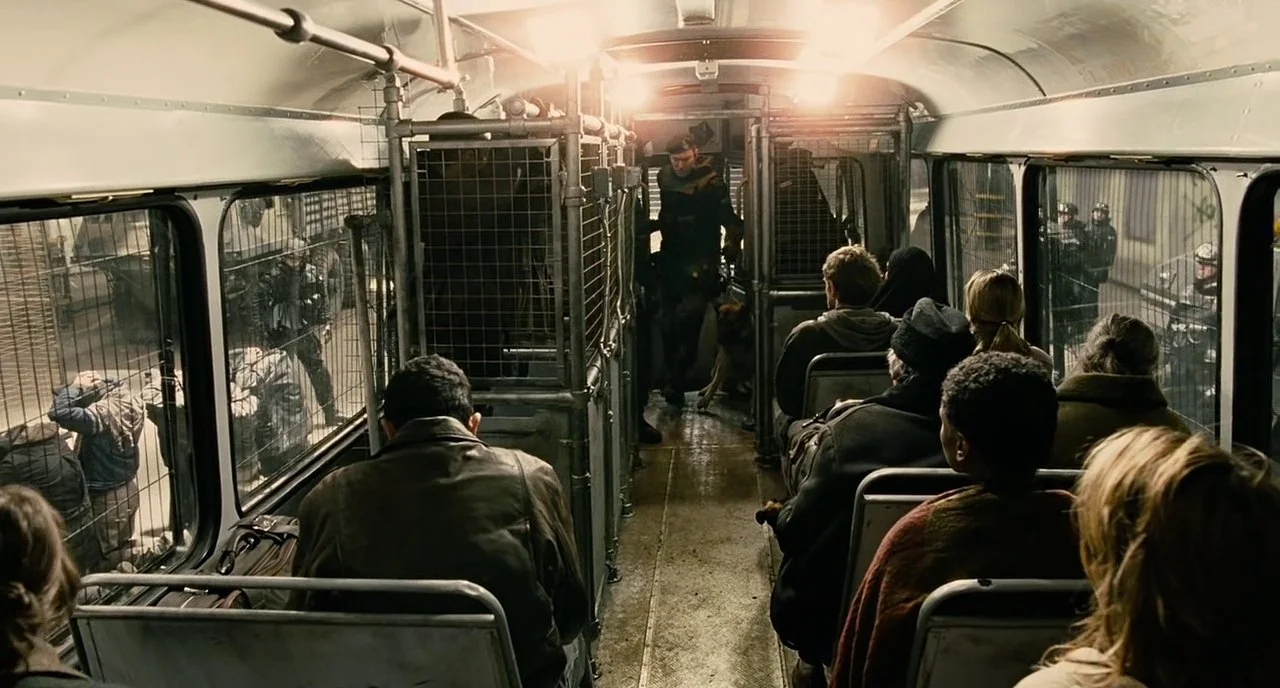
Children of Men (2006) • Universal
Participation offers no preservation.
The camera settles at the window as the bus moves away, and Miriam slowly disappears from view. With Miriam gone, the chain of people standing between Theo and responsibility collapses. There is now only him and Kee. Yet beyond the processing of bodies at Bexhill’s entrance lies a settlement, and people whose lives exceed the category into which the state has forced them: fugee.
Cuarón exposes how arbitrary this hierarchy of human value has always been. The state can deny recognition, but it cannot prevent people from constructing lives. Through the streets come shouting and crying, haggling and conversation; people smoke, sell, argue and search. Life persists within the machinery designed to contain it.
Theo and Kee make contact with Marichka, a woman surrounded by walls. Walls that are covered with missing-person posters. Where the state reduces people to a category, these walls insist upon specificity. Names. Faces. Relationships. People searching for people. Those who have been disappeared remain meaningful to somebody, and their absence is recorded by the people left behind. Bexhill may have been constructed to render its inhabitants politically disposable, but the lives within it resist that judgement simply by continuing to possess meaning for one another.
Kee’s contractions are becoming more frequent, and neither she nor Theo can continue to pretend that the birth is distant. Under Syd’s instruction, Theo implores Marichka to find them somewhere to stay and despite the language separating them, she agrees. Whatever arrangement exists between her and Syd, the care she extends toward Theo and Kee quickly exceeds the transaction that brought them together.
Crucially, Marichka does not know that Kee is pregnant.
There has been no revelation through which Kee suddenly becomes deserving of her attention, no miracle that transforms an anonymous stranger into somebody worthy of care. Marichka knows that two people need help navigating a place she understands better than they do. Perhaps she recognises the fear of arrival, of entering with nothing and knowing nobody, yet being expected to continue to wake up in the morning. Whatever the reason, she helps.
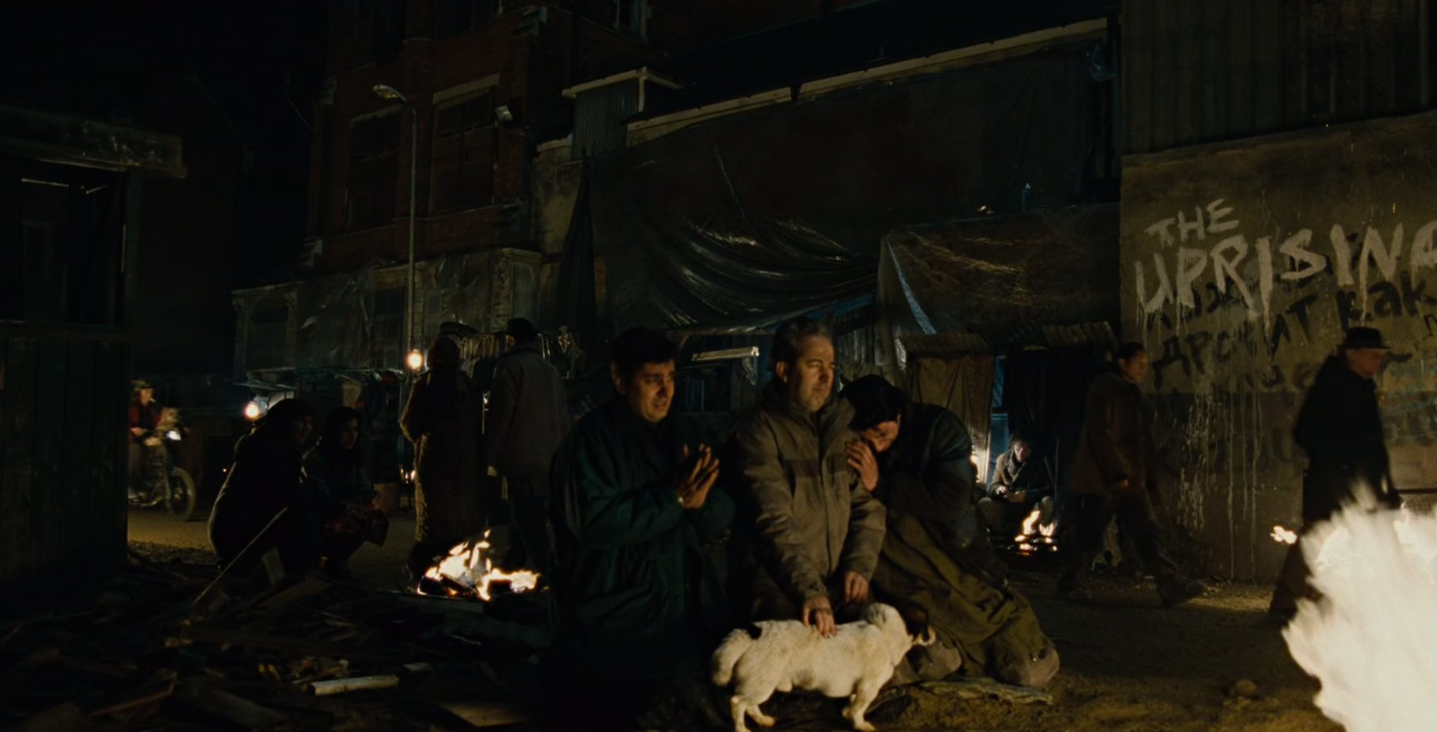
Children of Men (2006) • Universal
Bexhill has been constructed by a state that assigns value according to belonging, yet Marichka does not require Kee to be exceptional before treating her as a person. She leads them through the settlement and into a dilapidated apartment building. Kee cries out as the contractions intensify, struggling up the stairs and clutching at Theo while begging for the pain to stop. Without hesitation, he supports her. Miriam may have disappeared from the bus, but something of her remains in the instructions Theo repeats as he guides Kee towards the room. Knowledge passes from one person to another even as the person who carried it is lost.
Kee’s fear, and panic, is at its most visible upon Marichka’s departure. She lies on the dirty mattress and Theo focuses his attention solely on her needs. Outside the window, the Human Project, the Fishes, the state and Bexhill itself temporarily recede. Then, in a darkened, dilapidated room, illuminated only by lamplight, Kee gives birth.
There is no audience waiting for her. No physician. No government official. No revolutionary. No representative of the Human Project standing by to authenticate what has happened. The most historically consequential human event in eighteen years occurs almost anonymously, within the walls of a place built for people the state has determined do not matter. Kee is not the mother of a revolution. She is not evidence to be studied, a political contradiction to be concealed, or the vessel through which humanity might secure its continuation. The child is not yet a cause, an inheritance or a future to be possessed. The enormity of what has happened remains, but Cuarón reduces it to the scale at which it is actually experienced. A woman has given birth and a mother holds her daughter.
The child is extraordinary; the act itself profoundly ordinary. And in that distinction, the hierarchy upon which Bexhill has been constructed becomes harder to sustain. The baby’s arrival does not suddenly confer value upon the people confined there, nor does her birth ennoble a population that required no such justification. Instead, the circumstances of her arrival expose the poverty of the judgement that rendered those surrounding her disposable in the first place.
The first child born in eighteen years enters the world among people whose own lives have been denied recognition, and nothing about the miracle makes them more human than they were before. For one brief moment, before the rest of Bexhill learns that the child exists, the future of humanity belongs to nobody. She is simply Kee’s daughter.
But the room’s intimacy does not last. While Kee and her daughter sleep, a war is brewing. By morning, the Fishes’ uprising has turned Bexhill into a battlefield between competing claims to power. The distance they briefly enjoyed from the meanings awaiting them outside disappears with Syd’s arrival.
He is no longer dressed as an officer. Instead, Syd has adopted the clothes of the people he had once helped imprison, masking himself among the refugees as the authority that once afforded him protection begins to collapse. Jasper’s description of him as a fascist pig proves almost too generous in its suggestion of conviction. Syd appears interested in the sanctity of one singular thing: Syd. The state is valuable while its uniform grants him power. Once that power becomes dangerous, its victims provide an equally useful disguise.
Marichka is with him when the two discover what lies beneath Kee’s blanket. Her astonishment gives way almost immediately to action. Syd’s opportunism, by contrast, recognises value. The child becomes another thing that might be possessed. The revelation changes what Kee represents to him, but it does not change the logic through which he understands the world. To Syd, importance is something to be exploited.
Outside, the uprising advances.
All of them need to leave Bexhill, but Marichka turns upon Syd before any arrangement between them can be completed. Whatever transaction had brought him to the room is suddenly of little consequence. She recognises what his proximity to the child now means and refuses to permit it. Syd understands the child’s significance just as Marichka does. Recognition confers no moral claim. She offered assistance when Kee appeared to be nobody of consequence, another individual processed and discarded by the state. Now she risks herself because somebody else has decided that consequence entitles him to possession.
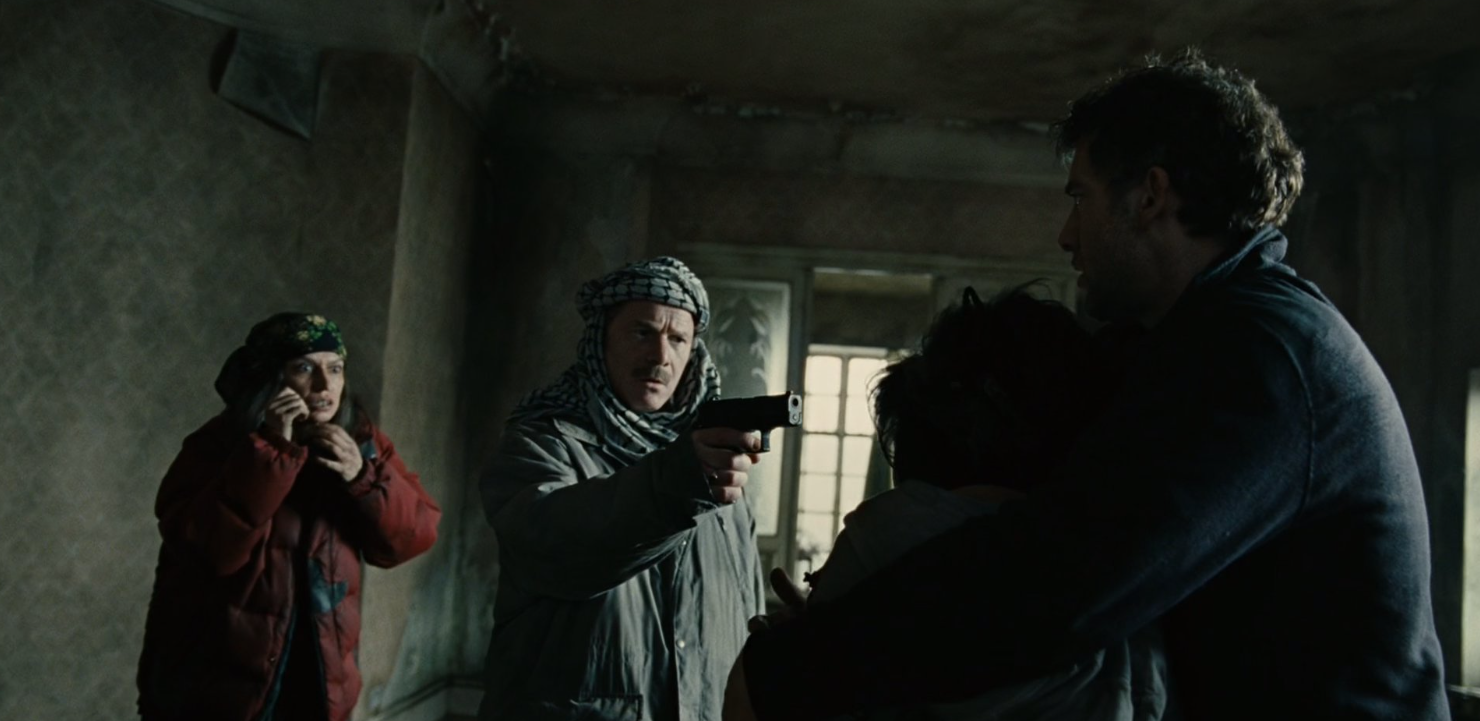
Children of Men (2006) • Universal
Cuarón does not centre their struggle. The camera remains with Theo and Kee as Marichka and Syd fight behind them, their violence taking place within the same restless depth of field through which the film has allowed competing human actions to coexist. Theo struggles with a metal door while, behind him, Syd attempts to overpower Marichka. There is no clean separation between foreground and background, between escape and danger. Both occur at once and the door, finally, gives. Theo and Kee pass through just as Syd breaks free. His weapon discharges after them, the bullet striking perilously close to the woman and infant whose value he has only just discovered. The idea of possession has already curdled into something more malformed. In his avarice, even the possibility of harming the child becomes secondary to preventing somebody else from taking her away.
Theo responds with a cinder block.
The violence is brusque. Ugly. There is no triumph in it. He does what is necessary, and keeps moving, emerging into a Bexhill transformed. Explosions shake the settlement. Soldiers advance through streets filled with people attempting to flee them, while militants answer from windows and rooftops. The divisions that have existed throughout Children of Men as propaganda, rhetoric and violence glimpsed at the periphery are suddenly compressed into the same physical space. Political meaning has become material: bodies, weapons, barricades, buildings collapsing beneath competing visions of what the world ought to be.
A procession passes through the camp, chanting allahu akbar, with their banners held aloft. It enters a visual language freighted with the anxieties of the post-9/11 world, without making Bexhill’s rebellion intelligible as a single ideology. Like the homeland security signage, it belongs to a future assembled from images already contemporary when the film was made. The state and those resisting it, each convinced of the necessity of their own actions, bring competing visions of order into direct collision. Their causes are not equivalent, nor are the moral claims through which they understand themselves interchangeable. But violence produces a recurring material fact regardless of the meanings used to justify it: somebody else must bear its cost.
Luke returns amid that collision. He may be right that the British state would struggle to accommodate the political reality of the first child in eighteen years being born to a fugee. His diagnosis, however, has become another justification for possession. He recognises Kee as the mother of something larger than herself and assumes that he must have the right to determine what happens to her. While Syd wants the child for the potential value that he can extract, Luke wants her for the political meaning that he can mobilise. Neither of these men leave any room for Kee.
When she is taken, Theo does not deliberate. Introduced walking through a city whose suffering had become environmental noise, Theo now moves directly toward the centre of its violence. What began as circumstance has accumulated into choice, repeated until action becomes the clearest expression of that which matters and Kee needs him.
As he searches for the mother he has resolved to protect, Cuarón and Lubezki follow. The extended movement through Bexhill represents the film’s commitment to witnessing at its most unforgiving. The camera ducks and dives through the violence surrounding Theo, avoiding the shrapnel and bullets that rip through the air. Violence concretely refuses to arrange itself politely around the narrative. Bodies fall at the periphery. The assault on Bexhill becomes an assault upon the senses. People appear for seconds and disappear again, running directionless, while soldiers fire upon buildings from which the Fishes answer them. We watch as entire lives intersect, but only because Theo happens to be manoeuvring through the same catastrophe.
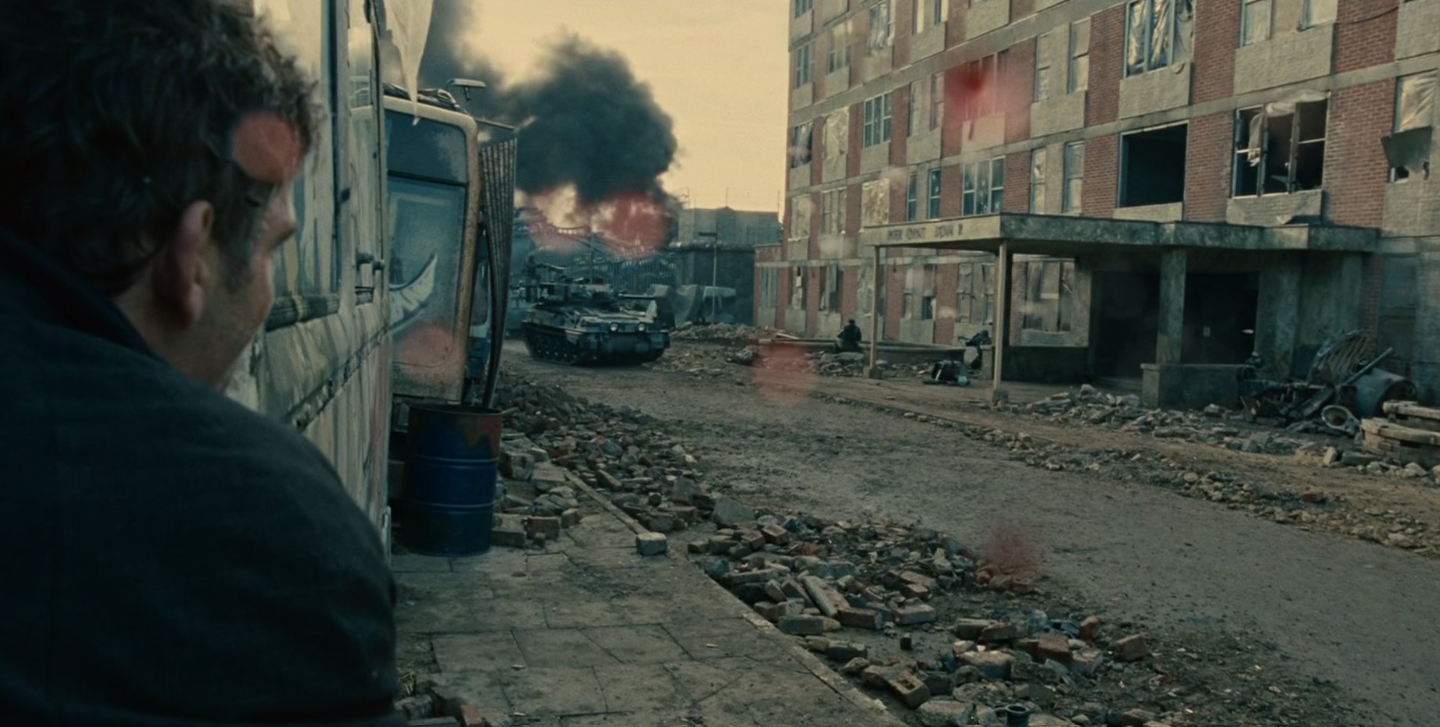
Children of Men (2006) • Universal
There is no privileged vantage point from which the violence can be understood. The camera cannot rise above Bexhill and make its competing interests coherent. It remains trapped at human height, running, stumbling, hiding, looking. When blood spatters the lens, an accidental intrusion retained within the sequence, the image appears contaminated by what it records. The apparatus of observation can no longer pretend to stand cleanly outside the world before it and neither can Theo.
Earlier, survival required him to move away from the deaths he witnessed. Now, Kee’s survival requires his movement toward the dread. He enters the besieged apartment block in which the Fishes have taken Kee and her daughter, clambering through a structure being dismantled by gunfire. Luke’s revolution has arrived at armed men claiming necessity over others, ordinary people becoming the material through which that necessity is expressed.
Then a sound so absurdly small breaks cover against the machinery that surrounds them. For eighteen years, nobody has heard a newborn cry. Beneath the screaming, gunfire and orders, a sound that once belonged to the world returns. It begins to travel before its significance can be understood.
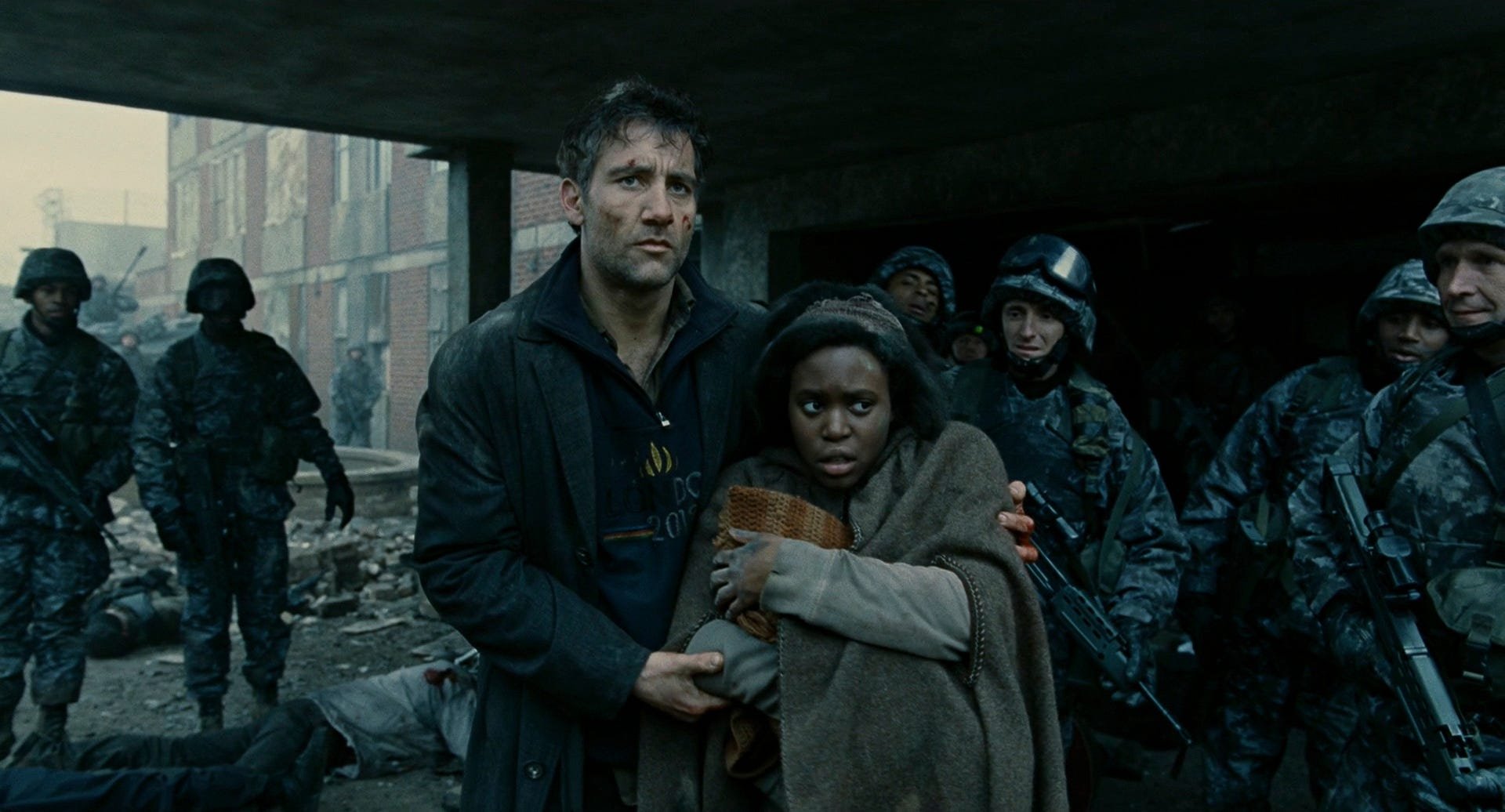
For a moment, a hush begins to spread through the building. People turn. As Theo and Kee descend, soldiers call for a ceasefire, and weapons once trained against others are lowered. Theo and Kee, the baby held between them, recognise an opportunity for safety. Hands reach towards the child along the stairs and faces collapse into disbelief. Some people stare, others burst into tears, and there are some whose faces turn towards the sky as they begin to pray. Such movements, curious and hopeful, spread throughout the building as violence which, moments earlier, appeared unceasing in its desire to devour the camp hangs in the air, suspended by something as ordinary as an infant protesting its discomfort.
Cuarón does not require the child to provide an argument that resolves the political convictions bubbling beneath the surface of that violence. Her existence precedes argument. Before anyone can organise her into policy, religion, revolution or science, she merely is. In a film preoccupied with the meanings human beings construct around power, loss, ownership and survival, the sound of another human life briefly becomes more compelling than the meanings for which people have been prepared to kill. Meaning rushes towards her. She is a miracle, a sacred thing, the possibility of continuation. But what stops the fighting is not knowledge of what she will become. It is recognition that she is here.
Theo and Kee walk through the building as though moving within a temporary breach in the logic of the world. Fighters who moments before would have killed one another make space for them. Soldiers watch. Fugees reach out. The child who, only hours earlier, had existed anonymously in a darkened room is now surrounded by people desperate to see, touch or bless her and for those few minutes, everybody seems to recognise a claim upon their attention, without any claim to possess her.
Children of Men (2006) • Universal
When Theo and Kee reach the street, a rocket tears through the pause and gunfire begins again. Cuarón permits the miracle to interrupt violence, but not to abolish its conditions. The state remains the state, the Fishes remain at war with it, and Bexhill remains a prison. The child has not resolved history by entering it. Nor does the return of violence invalidate the interruption. For a brief interval, people who had constructed reasons to kill encountered something for which those reasons were insufficient. Nothing was solved. The moment could not sustain itself, but permanence has never been the condition upon which experience becomes significant in Children of Men.
The moment existed and that is enough.
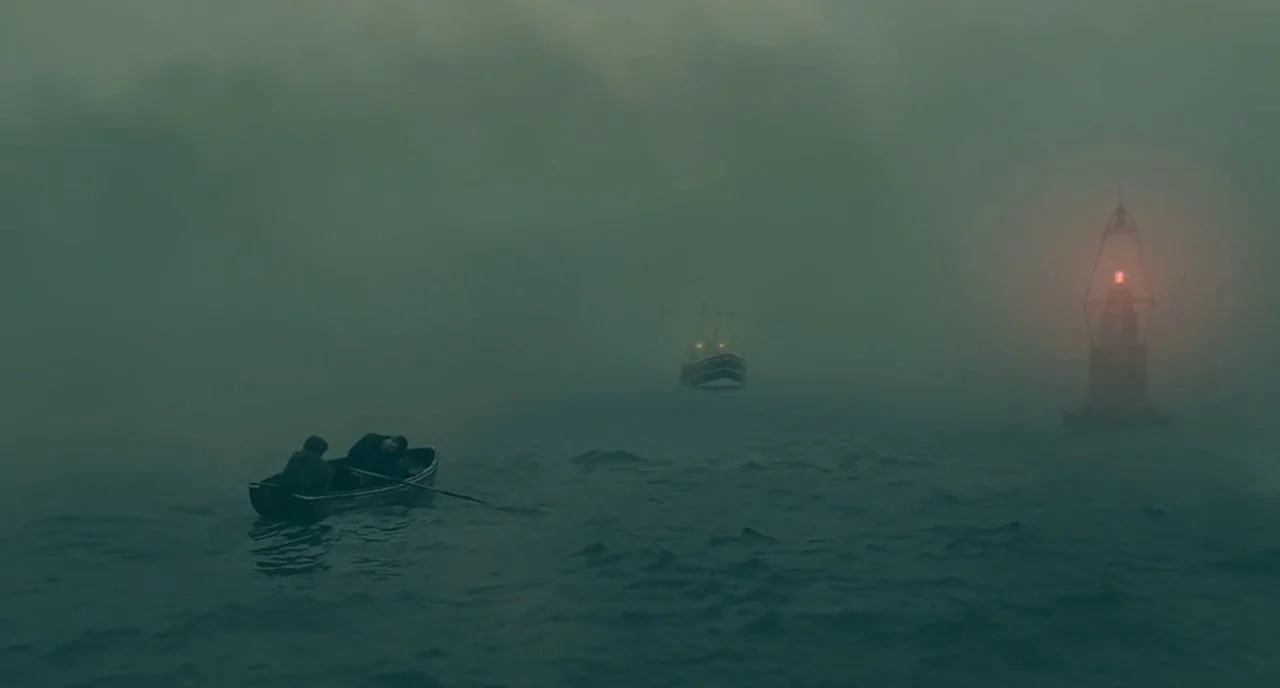
As Theo and Kee move out into the fog, choppy water striking the sides of the precarious boat beneath them, the structures through which the film has attempted to organise meaning begin to fall away.
Bexhill recedes. There is no state here, no revolution, no Human Project visible through the mist. There is only Kee, her daughter and Theo, suspended upon the water with little more than the hope that somebody will come. Kee’s doubt surfaces. The child is no longer an idea contained within her body. She is here, breathing, crying, requiring protection from a world into which she has been born without any promise that it has somewhere safe to put her. Kee fears they have arrived too late, and Theo assures her that they will be met. Whether he believes this with certainty is almost beside the point. Luke’s bullet has followed him out of Bexhill, and the cost of his final movement towards participation has begun to reveal itself.
The man who once reduced existence to the manageable repetitions of work, alcohol and isolation has spent the final hours of his life acting without the expectation that those actions must reward him. Meaning has returned not as the consequence of success, but through participation itself.
Above them, fighter jets cut through the fog, passing towards Bexhill as the distant violence continues without them. The state responds to disorder with the only language through which it still knows how to assert control, while on the water Theo turns his attention towards something infinitely smaller. When the baby begins to cry, Theo teaches Kee for one final time. He shows her how to wind her daughter, his hands moving instinctively around the memory of a child he has not held for almost twenty years.
Cuarón’s camera settles upon him as he demonstrates the motion against his own body. Theo sits trembling in the boat, bleeding into his clothes, his arms briefly assuming the shape of fatherhood again. The gesture is almost unbearably ordinary. Nothing about it will bring the son he lost back. It cannot guarantee Kee’s survival or determine what her daughter will become. He is simply passing something he knows to somebody who needs it. Knowledge, care and memory continue through an action so small that, against everything that has preceded it, it might almost go unnoticed.
He lives just long enough to learn that Kee intends to name her child after his own. The name that once represented the point at which Theo’s future disappeared is carried forward by somebody else. Then, without spectacle or some final declaration, Theo dies. No confirmation that he has saved humanity is required to make his actions matter. After a film in which death so often arrives amid gunfire, panic and forward motion, his departure is treated with a remarkable stillness. Kee calls his name, but there is nowhere left for him to go. His absence remains in the frame. Beyond the fog, a light materialises.
Children of Men (2006) • Universal
When the film fades to black, children can be heard. For most of Children of Men, their absence has sung louder than almost anything else. Miriam remembers how gradually playgrounds fell silent. Schools have decayed beneath vegetation; swings move in the wind, unaware that children should sit upon them. Humanity measures its approaching end through a sound that has vanished from the world. But Cuarón does not finish by showing what comes next. Instead, he allows the sound of children to suggest that something might. The future for humanity remains beyond the frame, as it always has.
Cuarón’s film is not ultimately concerned with whether humanity will survive, but with what human beings do while they are here: the values they construct, the people they love, the things they preserve, the violence they justify, the rituals through which they endure and the meanings they assign to lives whose endings they cannot prevent.
Theo’s journey contains love and estrangement, parenthood and bereavement, laughter, routine, friendship, political conviction, retreat, fear and, eventually, participation. He does not defeat death or live to discover what his actions achieve. Irrespective of what the future holds, there was life before it, and those lives meant something.
Julian brought Theo back from the brink and asked him to participate in the act of living once again. And so, in a way, did Dylan.