
Masters of the Universe
After a long road back to Eternia, Masters of the Universe still does not have the power.
2026 • Travis Knight • 140 min • Amazon MGM • Action / Adventure / Fantasy
Undone by the Power of Grayskull, and arguably by the Hollywood machinery surrounding it, Masters of the Universe reaches for the beginnings of a franchise capable of extending Mattel’s cinematic ambitions, but fails to truly transcend the calculation of its own existence.
There is an absurdist theatricality coursing through the bones of this material, much of it already present in the original series and toy line. Over the decades since, that theatricality has also made Masters of the Universe unusually receptive to queer interpretation: impossible male bodies, leather harnesses, secret identities, extravagant villains and the transformation of the comparatively unassuming Prince Adam into an object of hypermasculine spectacle have given He-Man a cultural afterlife steeped in homoeroticism and camp. Whether every element of that subtext was originally intentional is almost beside the point. It became part of the vocabulary through which the property has been understood.
Which makes the new film’s discomfort with its own excess all the more peculiar.
Masters of the Universe seems to buckle beneath the weight of its history, paralysed by the prospect of expectation. Its refusal to fully embrace that which makes the property entertaining leaves behind something stranger than simple disappointment: a slight discomfort, perhaps even, should anyone dare to say it, embarrassment.
Masters of the Universe (2026) • Amazon MGM
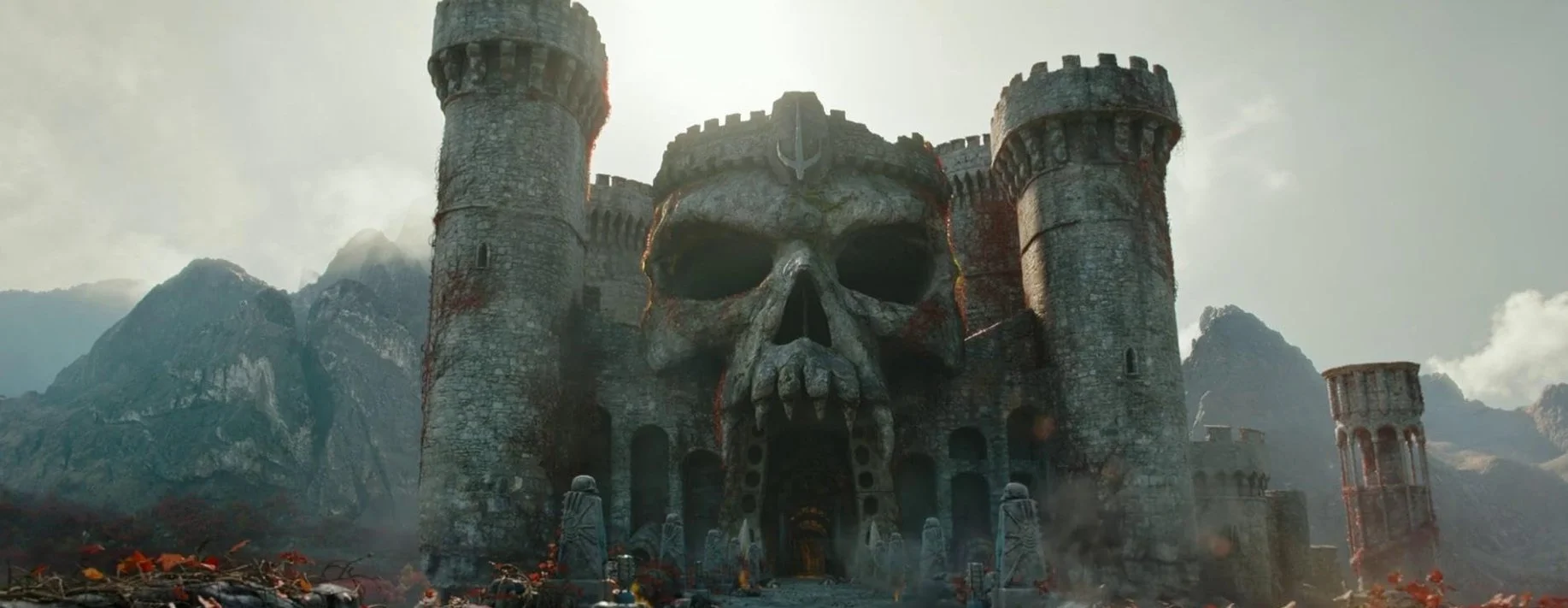
Eternia, ostensibly a place of mythic wonder and reverence, instead comes to be defined by its indebtedness to other, more confident franchises: spacecraft remarkably similar to those of Guardians of the Galaxy; machinery and movement indebted to the elastic futurism of The Incredibles; a forest pursuit whose grammar feels inherited, at times nearly lifted, from Star Wars; and a sequence of blacksmiths, soldiers and glowing metal that reaches instinctively for the industrial medievalism of Peter Jackson’s The Lord of the Rings. None of these references, on their own, would prove fatal. If only the film had as much audacity to commit to its own bit as it does to the forms of other pictures.
Cinema has, of course, always borrowed from itself. It is a visual art form continuously reinvented, rediscovered and redefined through the work that preceded it. Fantasy, in particular, has long been built from recognisable forms passed between generations. In the case of Masters, however, that familiarity underscores almost everything wrong with the film. Invention, it seems, is no longer necessary. Not when familiarity can do the work.
The result is a film in which familiarity becomes the strongest proof of concept an audience can hope to receive; one seemingly more interested in asking what a Masters of the Universe movie might resemble than what one could look like if permitted to become fully, unmistakably itself.
This is particularly egregious because the source material hardly lacks identity. He-Man belongs to a universe of impossible musculature, skull-faced tyrants, sorceresses, glowing swords and unapologetically theatrical design. There is a ridiculousness inherent in the mythology of He-Man. His best friend is a gargantuan warrior cat wearing bespoke armour. Ridiculousness is not an obstacle to overcome, nor a barrier to entry. It is the condition upon which Masters of the Universe works.
At least, in its original form.
Masters of the Universe (2026) • Amazon MGM
This adaptation approaches that strangeness repeatedly, only to retreat from the precipice whenever it comes close to surrendering to it. The costumes, though often aesthetically true to form, are seldom extravagant enough to become memorable and rarely feel truly owned by the characters wearing them. The iconography that made He-Man so recognisable is treated with acknowledgement rather than inhabitation.
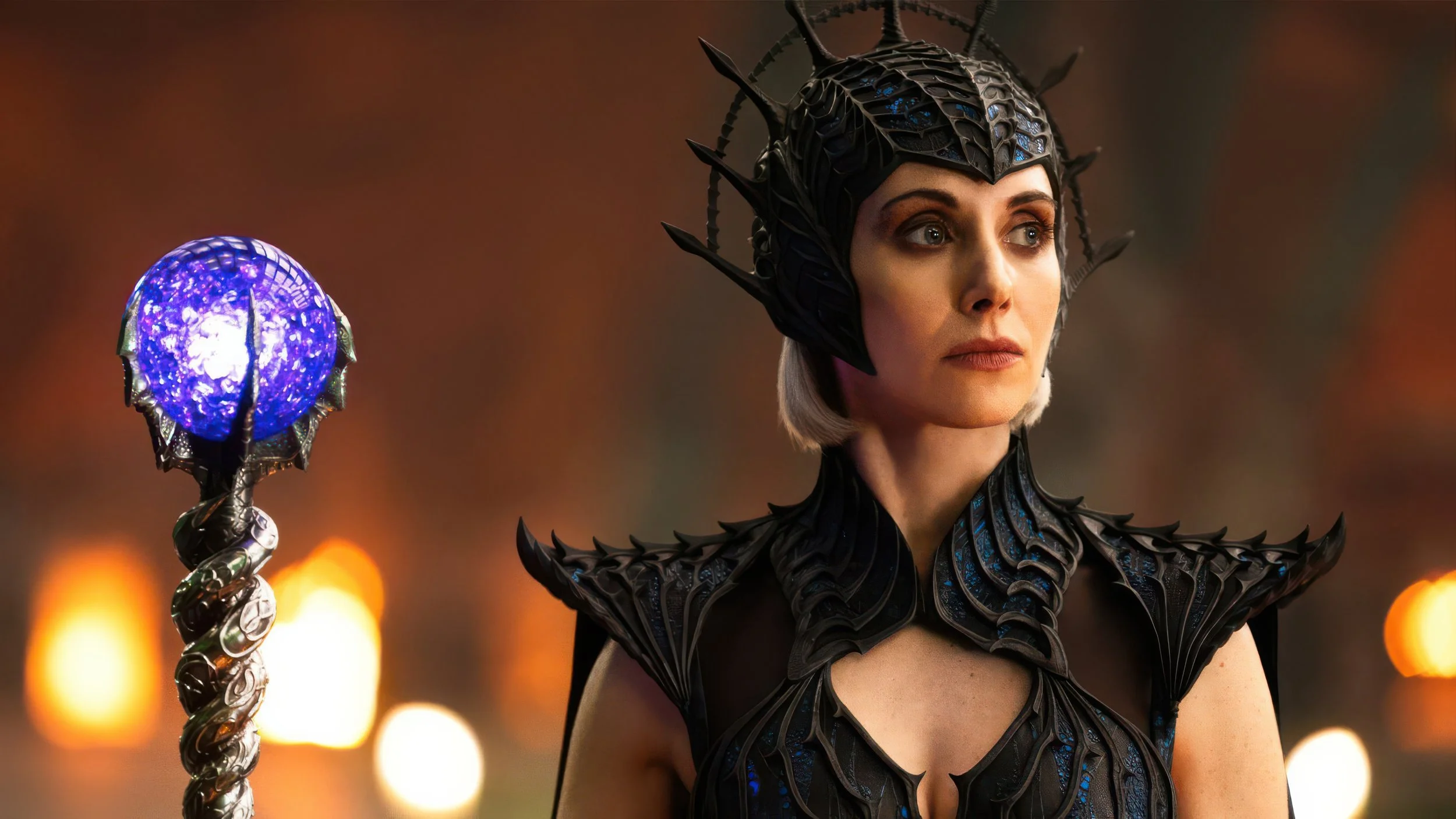
Evil-Lyn is perhaps one of the stranger casualties of this restraint. Her blonde styling already feels oddly anonymous for a character with such a distinctive visual history, but the decision becomes more frustrating when the film itself creates an opportunity to transform her and simply declines to take it. Even after Skeletor burns her, the film resists the obvious chance to recover the severe black-haired image associated with the character. Once again, Masters approaches its own iconography, only to flinch.
Even the Power Sword, an object supposedly imbued with extraordinary arcane properties, looks oddly insubstantial. Its mythic and physical weight rarely translates onscreen; it feels less like something forged than something manufactured for characters to hold in frame. Adam first discovers the sword in a comic-book shop and, unfortunately, nothing about its impractical, weightless construction ever allows it to completely escape the appearance of something that might belong there.
The film’s relationship with what came before consequently feels more commemorative than adaptive. It approaches the iconography of Masters of the Universe like a collection of heritage objects to be acknowledged rather than a vocabulary to be spoken fluently. It wants to confer upon this ludicrous world the legitimacy of serious fantasy while withholding almost every sliver of the excess that gives He-Man his unmistakable character.
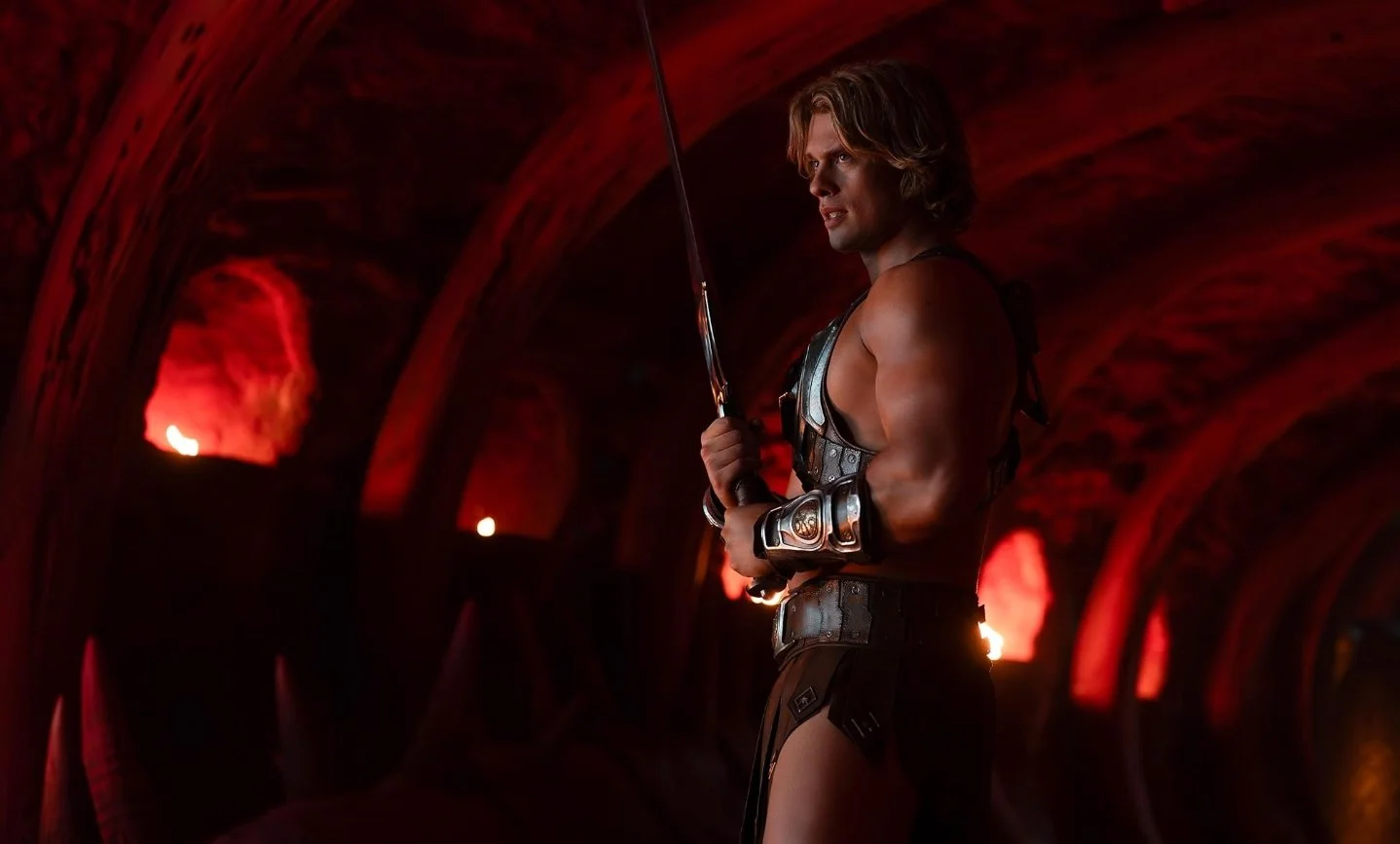
Nicholas Galitzine is an almost comically persuasive visual choice for He-Man. The face, the physique, the classical heroic proportions are all there. Aesthetically, the casting makes immediate sense. Yet the film seems uncertain about what to do with such an image once it finally has it, a problem underscored by how long it takes the audience to get there.
Too much of the film is instead occupied by the pointless grounded realism of Adam’s exile on Earth. What might have functioned as a brief collision between worlds metastasises into the dominant texture of the picture. Eternia becomes something to wait for. He-Man becomes somebody to wait for. Long after the film should feel as though it has gathered momentum, Adam still seems trapped inside the preliminary business of becoming the character whose name, image and mythology sold the viewer in the first place.
The Earth material also exposes the film’s uncertainty over tone. Adult jokes arrive with the conspicuousness of material inserted to reassure one portion of the audience that the filmmakers are aware of how silly all this is. Elsewhere, characters behave with almost defensive earnestness. Neither mode is especially fatal in isolation, but the movement between them produces the impression of a film continually negotiating with itself: sincere enough to qualify as fantasy, irreverent enough to avoid appearing naïve, recognisable enough to satisfy existing fans, contemporary enough to attract everybody else. The consequence is not breadth but friction.
The performances around Galitzine occupy much the same restrained dramatic register, as though psychological naturalism might somehow dignify material that has never required rescuing from its own absurdity. So many of these characters behave as though credibility depends upon playing everything straight when the material they have been given cries out for something larger, stranger and more theatrical.
Camp is not the same thing as mockery, and this is where the film repeatedly miscalculates.
The more interesting version of Masters of the Universe would not require its actors to wink constantly at the audience, nor would it need to collapse into parody. It would simply require everybody involved to commit to the ridiculousness with enough conviction that the ridiculousness becomes credible on its own terms. Heightening is not the enemy of sincerity. A knowingly theatrical performance does not have to cheapen the stakes.
In fact, in Skeletor, the film itself contains the evidence.
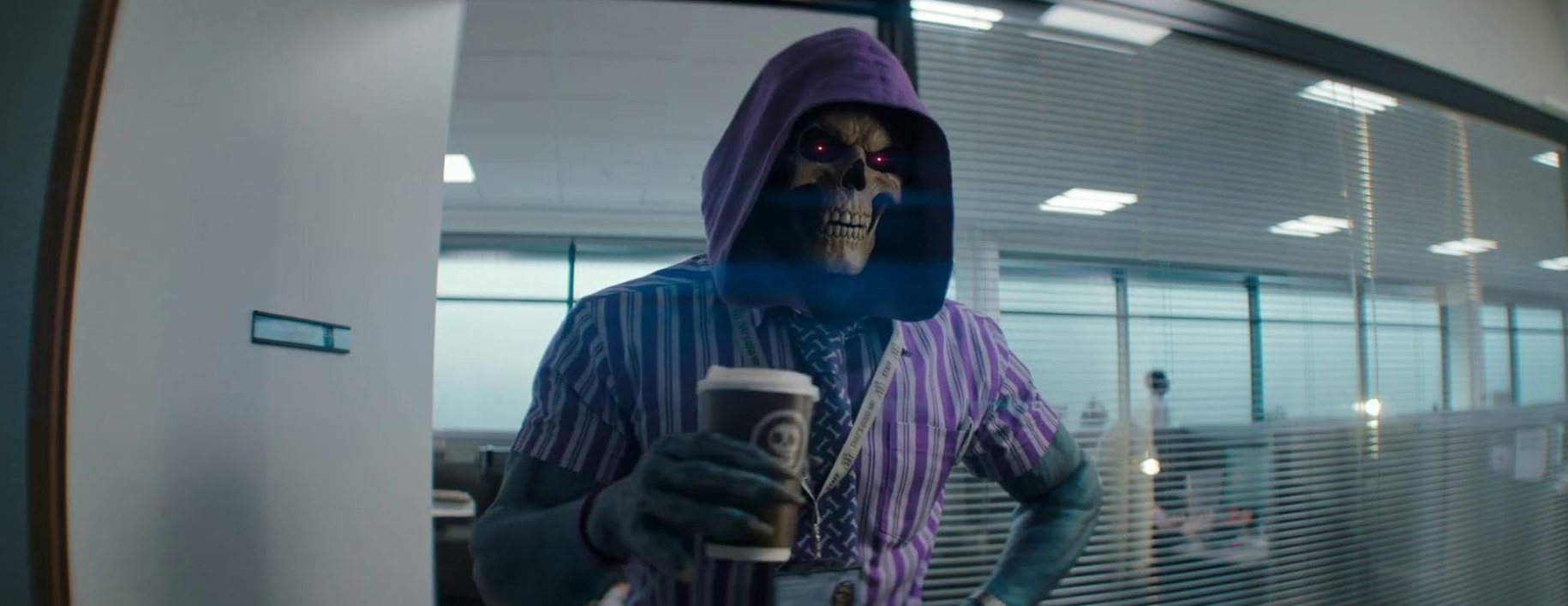
Jared Leto’s skull-faced megalomaniac is, improbably, exceptional, and exposes the very contradiction at the heart of the feature. Skeletor is played with precisely the excess the rest of the movie is reluctant to risk. He is flamboyant, outsized and frequently funny. There is also a distinctly queer charge to the performance because he is willing to embrace flamboyance, erotic menace, heightened gesture and performative masculinity in a film otherwise determined to suppress almost every comparable impulse. At points, his confrontations with He-Man even acquire a homoerotic charge that feels less imposed upon the material than excavated from a property long hospitable to precisely that kind of reading.
Masters of the Universe (2026) • Amazon MGM
And yet none of this prevents Skeletor from carrying genuine menace. There are moments in which he is truly frightening, not because the film suddenly changes register and borders on horror, but because Leto allows threat to exist within the character’s inherent theatricality. Skeletor’s campness does not undercut his dramatic function. It gives that function texture.
Perhaps, then, this should have been the lesson. Skeletor works because he is not embarrassed by the prospect of that which surrounds him. He does not demand any greater suspension of disbelief than the film has already secured by asking its audience to enter Eternia. A skull-faced tyrant attempting to rule a neon sword-and-planet kingdom through possession of a magical weapon is not an inherently serious proposition, and Leto never pretends otherwise. He simply plays it with absolute conviction.
There is an effectiveness in that complete surrender to the material that the rest of Masters of the Universe spends much of its runtime resisting.
It is difficult, too, to ignore the industrial shadow hanging over the film. In the wake of Barbie, Mattel hardly needed further evidence that the apparent absurdity of a toy property need not be disguised before it can survive translation to cinema. Greta Gerwig’s film found vitality precisely by interrogating the contradictions, artificiality and cultural baggage of the object at its centre. It did not make Barbie cinematic by sanding away that which was recognisably Barbie. It pushed those qualities until they became the film.
The comparison is useful not because Masters of the Universe should have replicated Gerwig’s metatextual approach, but because it appears to have learned precisely the wrong lesson from the success of adapting a toy into a blockbuster. Where Barbie treated intellectual property as material, Masters too often treats intellectual property as infrastructure.
There is a difference.
One produces a film whose peculiarities could not easily belong to anything else. The other produces a vehicle assembled from recognisable components, already conscious of sequels, audiences and franchise potential before it has established a compelling reason for this iteration to exist at all.
That is ultimately why the film’s innumerable cinematic references become so damaging. Had Masters of the Universe embraced its theatricality, had it been louder, stranger, queerer and more confidently ridiculous, those same references might have operated as play. A knowingly artificial space-fantasy could steal from Star Wars, The Lord of the Rings and Guardians of the Galaxy with a grin, folding decades of genre cinema into its own mythology. Quotation could have become part of the joke.
Instead, the film plays too much of itself with such dutiful seriousness that imitation is left exposed as imitation. When there is no distinctive voice through which an influence can pass, homage begins to look suspiciously like dependence.
And so Masters of the Universe arrives carrying almost everything a contemporary blockbuster is expected to possess: recognisable intellectual property, expensive visual effects, an aesthetically immaculate leading man, sequel-ready mythology, comic relief, nostalgia, enormous set pieces and an antagonist performed by an actor who, seemingly alone, understands the assignment.
What it cannot locate is the thing that made any of this worth resurrecting.
The tragedy is that Masters of the Universe does not fail because He-Man is too ridiculous for modern cinema. It fails because modern franchise cinema appears too embarrassed to be as ridiculous as He-Man requires.
For all its invocations of destiny, inheritance and latent power, the film is ultimately terrified of transformation. It borrows the appearance of other successful franchises, suppresses the excess of its own history and mistakes recognition for identity. By the time Prince Adam finally becomes He-Man, the movie surrounding him has spent so long avoiding becoming Masters of the Universe that the transformation feels almost beside the point.
The power was there all along: in the theatricality, the homoeroticism, the absurdity, the colour, the impossible bodies, the skull-faced villain and the enormous armoured cat. All the film had to do was wield it.
Instead, Masters of the Universe holds it at arm’s length like a prop.